A month is usually treated as nothing more than a block of time on a wall calendar. But in many traditional communities, the names given to months carry something much richer: direct observations about the land, the weather, what grows, what burns, and what people actually do with their hands during that period of the year.
The traditional Ewe calendar is one of the clearest examples of this anywhere in West Africa.
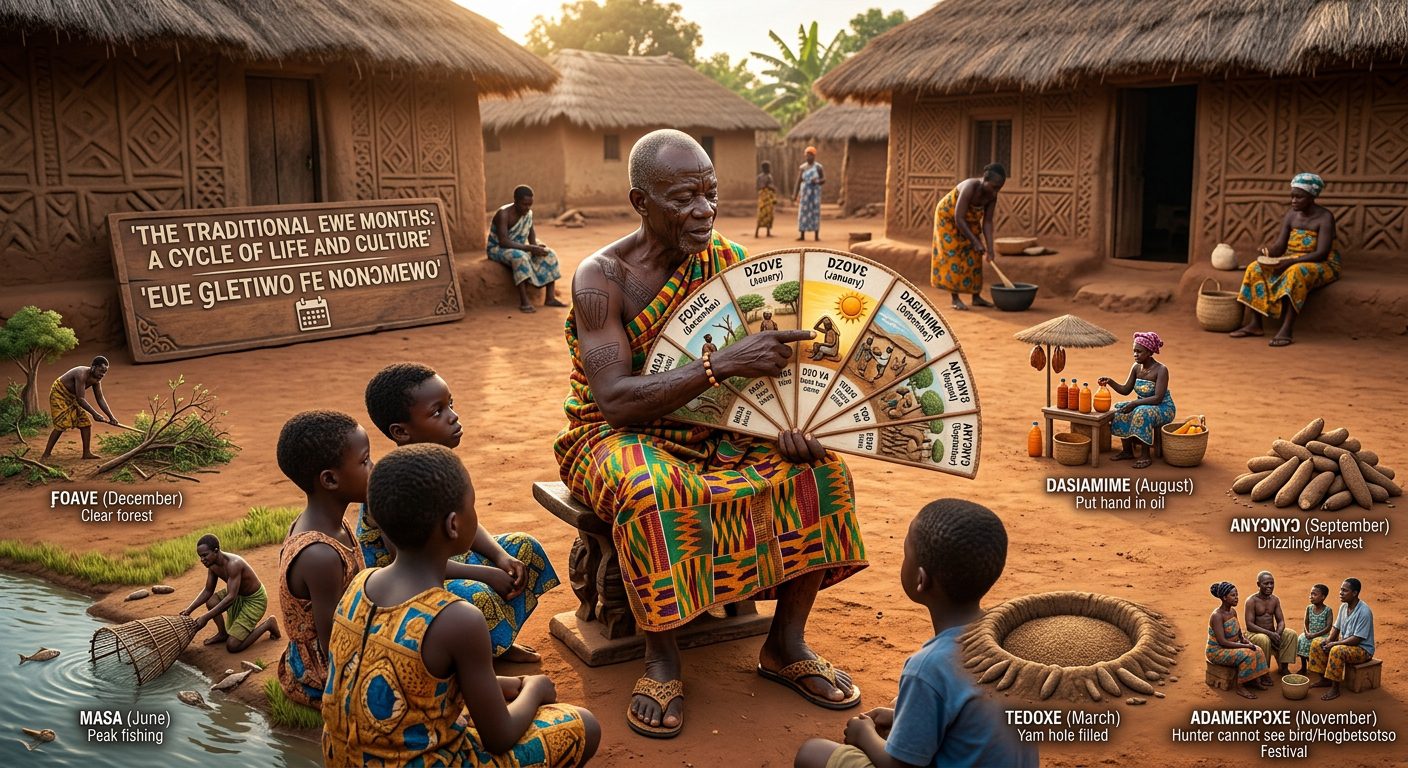
Among Ewe-speaking communities, the names for the months are tied to what people could see happening around them at that time of year: fire, dryness, the first rains, yam holes filling up, crops being dried and gathered, palm oil in season, drizzle, mist, hunting weather, and the bite of the harmattan. Put those names together and you get something that works like an environmental diary, written in the language itself.
Before going any further, though, there is something important to understand about the structure of the calendar.
Thirteen Months, Not Twelve
The traditional Ewe calendar is not simply a twelve-month version of the Gregorian calendar with Ewe names attached. Academic research describes an indigenous Ewe system of thirteen months, each tied to a 28-day lunar cycle and producing a 364-day year. The names come from natural events and the activities that traditionally filled people’s lives.
Today, the twelve Gregorian months also carry standardized Ewe names. Unicode’s Common Locale Data Repository (CLDR) records the following forms for January through December: dzove, dzodze, tedoxe, afɔfĩe, damɛ, masa, siamlɔm, deasiamime, anyɔnyɔ, kele, adeɛmekpɔxe and dzome.
The traditional thirteenth month is Ƒoave.
This distinction matters. The modern list of twelve months is useful for education and everyday communication. But it is not the same as the historical indigenous calendar, which had thirteen months. Both things can be true at the same time, and any serious discussion of Ewe month names needs to hold both in view.
You can explore how we used this calendar as a foundation for our Ewe Wall Calendar 2027, which includes the traditional month names alongside modern equivalents.
The Ewe Months at a Glance
The table below shows the traditional Ewe months alongside their modern Gregorian correspondence. That correspondence is included as a practical reference, not as evidence that the traditional calendar was originally built around the Gregorian system.
| No. | Modern Gregorian | Ewe Month | Traditional Association |
|---|---|---|---|
| 1 | January | Dzove | Intense dry conditions, heat and fire vulnerability |
| 2 | February | Dzodze | Fire visiting the grass; bushfire season |
| 3 | March | Tedoxe | First rains and yam holes being sealed |
| 4 | April | Afɔfĩe / Afɔfiɛ | Heat hot enough to burn the feet |
| 5 | May | Damɛ | Heavy rain, freshness and renewed planting |
| 6 | June | Masa | Heavy rain, greenery and agricultural activity |
| 7 | July | Siamlɔm | Drying and gathering crops |
| 8 | August | Deasiamime / Dasiamime | Putting the hand into oil; palm-oil season |
| 9 | September | Anyɔnyɔ | Persistent drizzle and new-yam harvesting |
| 10 | October | Kele | Storms and the growth of a shrub called kele |
| 11 | November | Adeɛmekpɔxe | Mist and difficulty for hunters seeing birds |
| 12 | December | Dzome | Severe harmattan, dryness and discomfort |
| 13 | Traditional extra month | Ƒoave | Drying vegetation and the apparent clearing of forest |
Spelling variations exist across sources. Unicode CLDR uses forms such as afɔfĩe and deasiamime, while other reputable sources use Afɔfiɛ and Dasiamime. This article preserves the forms found in each source rather than forcing one standard onto all of them.
Each Month in Detail
1. Dzove: January
Dzove opens the traditional Ewe year in the middle of the dry season. Researchers Aziaku and Akyea describe this period as one of intense dryness, high daytime temperatures, desiccating winds and cold nights. Vegetation becomes dry and highly combustible. The name connects dzo (fire) with an element associated with scarcity, pointing to the particularly high fire risk of the period. Land was cleared for cultivation during this time, and fire was part of how farmers prepared fields. Dzove is better understood as a month of severe dryness, heat and fire danger than as simply “a hot month.”
2. Dzodze: February
The conditions of Dzove continue and intensify into Dzodze. The name is a shortened form of dzo dze gbe, literally “fire has visited the grass.” Bushfires were common during this period. Farmers burned cleared land, hunters used fire as part of their practice, and herders burned old grass to encourage fresh growth after the rains. The short description “month of wildfire” works, but “fire has visited the grass” gives a truer sense of what the traditional name is actually saying.
3. Tedoxe: March
After the long dry season, the first rains arrive during Tedoxe. According to the field research of Aziaku and Akyea, these rains cover the yam mounds or holes that had remained open after the previous harvest, which is where the name comes from: tedoxe literally means “yam-hole-sealed.” Farmers also use this period to plant yam, maize, cassava, plantain, banana, cocoyam and vegetables. Tedoxe is therefore more than a name for a seasonal transition. It marks the moment when the ground is ready and the farming year restarts.
4. Afɔfĩe / Afɔfiɛ: April
Afɔfĩe is associated with an intensely hot period. The name breaks down through afɔ (foot) and a verb connected with burning. Field research by the same University of Cape Coast team describes people, including children returning from farms or streams, experiencing real discomfort from the heat of the ground and stopping under trees or stepping on dry leaves to cool their feet. The meaning “burned feet” or “the feet are burned” is not a poetic invention for an English-language summary. It reflects an actual environmental experience tied to this part of the year.
5. Damɛ: May
Damɛ belongs to the wetter part of the agricultural cycle. The academic research describes this month and the following one as periods of heavy rainfall, with the environment turning green and fresh. Farmers who could not plant during the drier months get another opportunity here. Crops associated with this period include water yam, beans and cotton, while farmers also stake new yam plants, harvest the first maize and deal with early weeds. Damɛ is a month of heavy rain, renewed greenery and intensive agricultural activity.
6. Masa: June
Masa follows Damɛ and continues the same wet, agriculturally active period. The research describes them together as months of heavy rainfall, greenery and freshness. The name Masa is also widely associated with a tree in popular explanations, but the strongest source located for this article does not provide enough detail to establish a firm botanical connection. What is clear is that Masa is the Ewe name for June and belongs to the wet and productive part of the traditional agricultural year. Unicode independently records masa as the Ewe name for the sixth month.
7. Siamlɔm: July
Siamlɔm is one of the most expressive month names in any calendar system. As the heavy rains of Damɛ and Masa start to ease off, there are bursts of sunshine interrupted by drizzle, and crops planted earlier are approaching maturity without being quite ready. Maize needs to be harvested and dried, but the rain keeps interrupting the process. The researchers break the name down as siam (dry me) and lɔm (gather or collect me), giving: “dry me, gather me.” It is a farming rhythm preserved directly in the name of the month.
8. Deasiamime / Dasiamime: August
The eighth month has one of the most vivid literal meanings in the calendar. The name breaks down as de (put into), asi (hand), ami (oil) and me (inside), together meaning “put your hand into oil.” The researchers found two explanations in the field: one connecting the image with impatient or hungry children getting oil on their hands, and another pointing to the widespread use of palm oil in meals during a period of palm-fruit abundance. The literal meaning is well documented. The specific story behind it has more than one version, and both are worth knowing.
9. Anyɔnyɔ: September
Anyɔnyɔ is the month of incessant drizzle. The Ewe word nyɔnyɔ refers to this type of persistent light rain, and it gives the month its name. But September is also when new yam is harvested and when the major Ewe traditional Yam Festival, the Tεzã, is held. Rainfall, agriculture, harvest and cultural celebration all fall in the same seasonal period here, which makes Anyɔnyɔ particularly significant in the Ewe calendar year.
10. Kele: October
Kele is sometimes described simply as “the last rainy month,” but that misses the reason for the name. The academic sources describe this as a period of destructive storms and the abundant growth of a shrub or plant locally called kele. The plant grows tall and thick during this period, and its name carries over to the month. Harmattan is beginning to approach and agricultural conditions are changing. Kele is a stormy period associated with the growth of kele vegetation and the approaching end of the rainy agricultural cycle, not just “the last wet month.”
11. Adeɛmekpɔxe: November
This is arguably the most linguistically remarkable name in the calendar. The month is characterized by foggy, misty conditions, while fruit becoming abundant draws animals and birds out of their hiding places, making it a productive time for hunters. There is just one problem: visibility is poor. The name breaks down as adeɛ-a (the hunter), ma (cannot), kpɔ (see), xe (bird). Put together: “the hunter cannot see the bird.” Weather, wildlife and human occupation are all encoded in a single month name.
12. Dzome: December
Dzome brings the traditional twelve-month cycle into the severe harmattan. The research analyzes the name as dzo (fire) plus me (inside), expressing the excessive heat, biting dryness and discomfort of the harmattan period. Describing Dzome simply as “continued harmattan” captures the climate but loses the force of the expression. “Fire inside” is much closer to what the traditional name is actually conveying.
13. Ƒoave: The Thirteenth Month
The traditional Ewe calendar does not end with Dzome. It continues with Ƒoave, the thirteenth month, which Aziaku and Akyea explicitly identify as the last month of the indigenous Ewe year. During Ƒoave, the harsh conditions of December become even more severe. Trees lose their leaves, vegetation dries up and rivers may begin to fall or dry. The name breaks down as ƒo (clear) plus ave (forest), giving the sense that the dry conditions have cleared the forest itself.
Modern lists of Ewe month names often stop at December, which is useful for mapping Ewe names onto the Gregorian calendar. But those lists can obscure the thirteenth month of the traditional system. Unicode’s CLDR independently preserves ƒoave in its calendar data as a thirteenth Ewe month, which is useful confirmation that this is not just an obscure academic detail.
What the Calendar Tells Us as a Complete Sequence
When you read the thirteen months together, they form a coherent seasonal story:
Dryness, heat and fire risk in the early months. The first rains arrive. Farms become active. The landscape turns green. Crops mature and must be repeatedly dried and gathered before the rain interrupts. Palm oil comes into season. Drizzle accompanies the yam harvest and festival period. Storms and mist follow. Then the harmattan takes hold. And finally the dry season becomes so severe that the vegetation appears stripped from the land.
Aziaku and Akyea make the point directly in their research: the Ewe monthly names are drawn from natural events and the activities connected with people’s occupations and lives. Their study was specifically concerned with what happens when climatic change disrupts the relationship between the traditional names of months and the environmental conditions those names describe.
That connection makes the calendar something more than a historical document. It is a record of environmental memory preserved in language.
Agriculture Is at the Center
Farming appears repeatedly across the month names. Tedoxe is tied to the first rains and yam cultivation. Damɛ and Masa bring planting. Siamlɔm describes the work of drying and gathering crops. Anyɔnyɔ is connected to new-yam harvest. Kele marks the end of the main agricultural cycle.
Traditional Ewe farming depended heavily on rainfall, which is why the relationship between seasons and agricultural activities was so carefully observed and so deeply embedded in the language. You can read more about how this agricultural knowledge connects to language preservation in our article on why African languages are disappearing and what can be done about it.
The Names Also Record the Natural World
Not everything in the calendar is about farming. The month names also refer to fire (Dzove and Dzodze), rain across multiple months, vegetation particularly in Kele and Ƒoave, oil in Dasiamime, hunting and birds in Adeɛmekpɔxe, and harmattan in Dzome. Nature became a kind of clock, and the question was not only “which month is this?” but also “what is happening around us?”
This kind of embedded environmental observation is something Ewe proverbs also carry in their own way. Both the proverbs and the calendar names are forms of knowledge that the language has carried across generations.
Modern Use and the Two Systems
Today, Ewe speakers use the Gregorian calendar alongside the traditional Ewe month names. Unicode’s CLDR formally records all twelve modern Ewe month names for digital and educational use. That is valuable for technology, language learning and everyday communication.
But the traditional calendar has thirteen months of twenty-eight days, giving a 364-day year. These two systems sit alongside each other. They are related but not identical ways of organizing time. Treating one as simply a translation of the other misses most of what makes the traditional system interesting.
If you want to see the traditional month names in print, our Ewe Wall Calendar 2027 includes them alongside Gregorian dates and cultural reference points. We also have an Ewe Phrase Book if you want to go further with the language itself.
Why These Names Should Not Be Forgotten
When a month name disappears, what goes with it is not just a vocabulary word. It is the observation embedded in that word: the heat of the ground underfoot in April, the danger of fire in February, the moment when the rains arrive and seal the yam holes in March, the complicated dance of drying and gathering crops before the rain interrupts in July.
These are pieces of Ewe environmental memory, and the Ewe language has been carrying them long before there was a Gregorian calendar to compare them to. Documenting them well is part of making sure they remain accessible to future generations.
Sources
- Aziaku, Vincent Erskine and Akyea, Gladys M. F. “The Ewe Indigenous Calendar and Climate Change.” Department of Ghanaian Languages, University of Cape Coast.
- Jim-Fugar, M. K. N. and Jim-Fugar, Nicholine. Nuseline’s Ewe-English Dictionary (2017).
- Unicode Consortium, Common Locale Data Repository (CLDR), Ewe locale data. Also records ƒoave as a thirteenth Ewe month in calendar data.
The Gregorian month labels in this article are provided for modern orientation and language-learning purposes. Where Ewe words have variant spellings across reputable sources, both forms are preserved rather than arbitrarily declaring one the only correct form.
Language Roots Hub: Preserving African Languages, One Word, One Story and One Tradition at a Time.
Leave a Reply