Preserving West African Languages One Dictionary at a Time
Language Roots Hub builds free, searchable, trilingual dictionaries, cultural phrase books, and heritage calendars for the living languages of West Africa, so that the speakers of those languages can find their own words online, in their own tongue.
Why this project started
Language Roots Hub was founded by Bro Jerry, a Ghanaian pastor, author, and educator with a deep burden for cultural and linguistic preservation. The project began with a single question: why is it so hard to look up a word in Nawdm online?
Nawdm is spoken by the Nawdba people across the Oti Region of Ghana and the Kara region of Togo. It has been documented by linguists and missionaries for decades. The vocabulary exists. The research exists. But for an ordinary Nawdba speaker with a phone, there was no place to simply search for a word in their own language.
That is the gap Language Roots Hub was built to close, not just for Nawdm, but for every West African language that deserves to be as searchable online as English or French.
What started as one dictionary has grown into a full platform: five dictionaries, five phrase books, and six cultural calendars, all free to use or affordable to own, all built with the same care for accuracy and respect for the communities whose languages these are.
“A language spoken by fifty thousand people is not less worth documenting than one spoken by fifty million. Both communities deserve the same basic digital tools.”
— Bro Jerry, Founder, Language Roots Hub
What Language Roots Hub offers
Three types of resource, all built around the same mission: make West African languages findable, learnable, and liveable.
Free Online Dictionaries
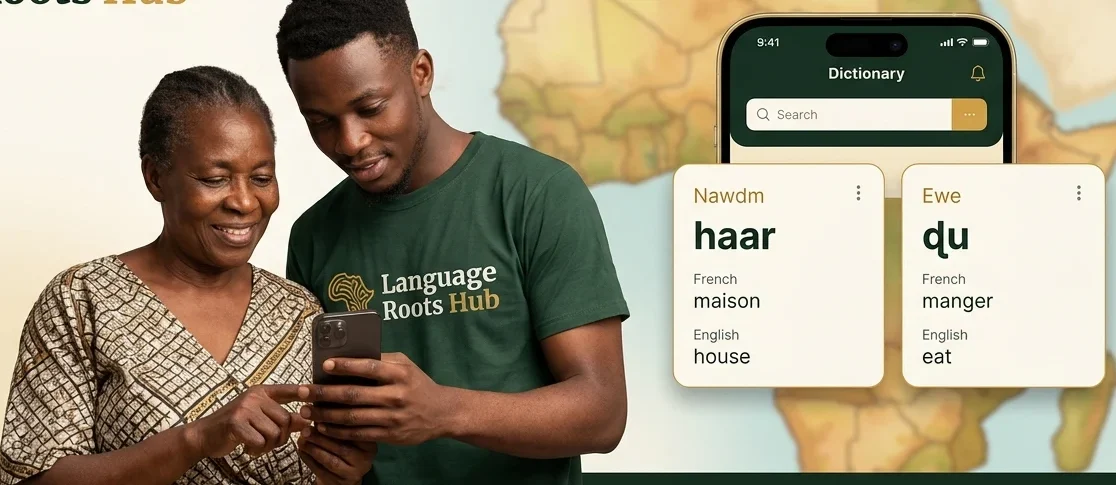
Trilingual searchable dictionaries in Nawdm, Ewe (Nyagbalẽ), Kabiyè, Twi, and Gã. Search in any of the three languages — the local language, French, or English — and find the word you need instantly. Free to use, no login required, works on any phone.
Cultural Phrase Books
Beautifully designed PDF phrase books for Twi, Ewe, Gã, Nawdm, and Kabiyè. Each book covers core greetings, numbers, days, family, food, and cultural notes — everything a learner, traveler, researcher, or diaspora family member needs to connect with a language. Download instantly via Paystack.
Heritage Wall Calendars
Twelve-month wall calendars in Nawdm, Ewe, Gã, Kabiyè, and Twi. These are the only calendars of their kind published anywhere in the world. Each calendar carries the language’s traditional month names, cultural festivals, and public holidays in three languages.
The languages we serve
Five living West African languages, each with its own history, community, and digital presence on Language Roots Hub.
Nawdm
Togo · Ghana (Oti Region)
The language of the Nawdba people. ISO 639-3: nmz. Spoken across Niamtougou in northern Togo and the Oti Region of Ghana. One of the rarest languages with a dedicated online dictionary.
Ewe (Nyagbalẽ)
Ghana · Togo · Benin
A major West African language with millions of speakers across the Volta Region of Ghana, southern Togo, and parts of Benin. ISO 639-3: ewe. Rich oral and musical traditions.
Kabiyè
Togo · Ghana
The second national language of Togo, spoken by over a million people in the Kara region and its diaspora. Home of the Évala wrestling festival, one of West Africa’s greatest traditional rites.
Twi (Akan)
Ghana
One of Ghana’s most widely spoken languages, covering Asante Twi, Akuapem Twi, and Bono Twi. The Akan people gave the world the Adinkra symbol system and a culture of proverbs spanning centuries.
Gã (GaWiemɔ)
Greater Accra · Ghana
The original language of Accra and the Gã people of the Greater Accra Region. Home of the Homowo harvest festival, Kplejoo ceremonies, and a vibrant coastal culture.
How every dictionary is built
Every resource on Language Roots Hub starts with the same commitment: accuracy before everything. No word is added carelessly. Every entry is cross-referenced in the local language, French, and English, so it is genuinely useful to speakers, learners, and researchers at the same time.
Building for languages with limited digital presence means going beyond what already exists. That is what makes this work different: not just digitizing what is already published, but filling the gaps by adding translations where none existed, correcting errors that crept into older sources, and making everything searchable through a free, modern app anyone can use on their phone.
No dictionary of a living language is ever finished. Every dictionary on Language Roots Hub has a built-in suggestion tool. If you find something that does not look right, you can submit a correction and we review every one personally before any change is made.
Source from verified material
Published reference dictionaries, academic word lists, and community-verified language documents form the foundation of every dictionary.
Add trilingual translations
Every entry is translated and cross-referenced in the local language, French, and English, making it useful across three language communities at once.
Review and verify carefully
Every entry is personally reviewed by our team before publication. Community members and native speakers are invited to flag and correct anything that does not look right.
Build and publish as a free app
Each dictionary is published as a free progressive web app that works on any phone, even with limited internet, and it is kept updated as corrections and additions come in.
Start exploring West African languages today
Whether you are a speaker, a learner, a researcher, a diaspora family, or simply someone who believes African languages deserve better digital tools, Language Roots Hub is for you. Everything here was built with care, and it is growing.
Explore the Dictionaries →
Browse Phrase Books and Calendars →
A note on sources and attribution
The dictionaries on Language Roots Hub were built from multiple sources: published reference material, academic word lists, openly available community and educational language resources, and direct verification from native speakers. Word meanings are facts about a language. They belong to the people who speak that language. Where an entry here resembles something in an existing dictionary, that reflects the language being represented accurately, not copying.
What is original to this project is real: English and French translations added where none existed before, personal review and correction of all translated material, cross-referencing across three languages at once, and the searchable apps and websites themselves, none of which existed before this project.
We are genuinely grateful to the researchers, linguists, and community contributors whose earlier work gave each of these languages a starting point. If you are a researcher, publisher, or community member with a concern about how any specific material is represented here, we welcome that conversation directly through the Support page.