
The Ewe people, who live primarily in the Volta Region of Ghana and the southern parts of Togo and Benin, have one of the richest proverb traditions in West Africa. For the Ewe, a proverb is not just a clever saying. It is a tool for teaching, settling disputes, correcting behavior, expressing grief, and celebrating life. Elders deploy proverbs in conversations the way a craftsman uses tools, each one chosen for the precise situation it was built to address.
Ewe proverbs are called lododowo (singular: lododo; plural: lododowo), which can be loosely translated as “wisdom words.” They are passed down through generations in oral form, meaning that slight variations may exist between Ewe-speaking communities in Ghana and Togo. What remains constant is the underlying wisdom.
This article presents a selection of Ewe proverbs, their literal translations, and the deeper cultural meanings they carry.
1. “Ame le ame ŋu.”
Literal meaning: A person leans on a person.
Deep meaning: No human being is self-sufficient. Everyone, no matter how capable or successful, depends on others at some point in their life. This proverb is used to remind people of their responsibility toward the community and to discourage pride or arrogance. The Ewe worldview is deeply communal, and this saying captures that spirit perfectly. When someone becomes too self-reliant or cuts themselves off from community, this proverb is often invoked.
2. “Gbe ɖeka mede ati o.”
Literal meaning: One tree alone does not make a forest.
Deep meaning: Nothing significant is achieved by one person working in isolation. A forest requires many trees. A community requires many people working together. This proverb is commonly used in leadership contexts, community organizing, and family matters, wherever unity and cooperation are being encouraged. It is a reminder that strength comes from togetherness, not from standing alone.
3. “Ame nyui ɖeka megawo gbe o.”
Literal meaning: One good person alone cannot build a community.
Deep meaning: Even if one person has excellent character, a thriving society requires many people of good character working together. This proverb is often used in discussions about leadership, governance, and community building. It challenges individuals to look beyond themselves and consider what they contribute to their group.
4. “Nɔvi wu nɔvi.”
Literal meaning: A sibling surpasses a sibling. / A relative is more than a relative.
Deep meaning: This is a proverb about the unmatched value of family. No friendship, no matter how deep, fully replaces the bond of kinship. The Ewe use this saying to encourage people to stay connected to their family ties and not to neglect relatives in pursuit of outside relationships or material ambitions. It is often said to someone who has grown distant from their family.
5. “Dɔwɔwɔ le nu me.”
Literal meaning: Work is inside (something). / The result is in the work.
Deep meaning: What you seek is found through effort. There are no rewards without labor. This proverb is used to motivate and encourage persistence. Ewe farming communities, who depended heavily on agriculture, developed a deep respect for hard work, and this saying reflects that value. It is often told to young people who want quick rewards without putting in effort.
6. “Ŋkeke ɖeka medo dzo o.”
Literal meaning: One day alone does not make a fire.
Deep meaning: Patience and persistence are required for anything meaningful. A single day’s effort is rarely enough. Great things are built over time, through consistent, daily commitment. This proverb is used to counsel people who become frustrated when results do not come quickly. It teaches that good things take time and that endurance is a form of wisdom.
7. “Tsitre le nu me.”
Literal meaning: Silence has something inside it. / Silence holds something within.
Deep meaning: Knowing when not to speak is a mark of wisdom. The Ewe people place high value on thoughtful speech, and this proverb is used to caution against hasty words. Silence is not emptiness; it is often filled with understanding, patience, and strategic thought. An elder who is silent in a conflict is not indifferent. They are listening and thinking deeply.
8. “Agbe nye aɖe o.”
Literal meaning: Life is not nothing. / Life is not a trivial matter.
Deep meaning: Life must be treated with seriousness and respect. This proverb is used in situations involving risk, recklessness, or carelessness with one’s health and safety. It is also used during mourning, to remind the living of how precious and fragile life is. In a broader sense, it encourages people to live purposefully and not waste the gift of life on meaningless pursuits.
9. “Wo le ŋu la, nà wɔ dɔ.”
Literal meaning: While you have life / strength, do work.
Deep meaning: Use your time and energy wisely. Do not wait until you are old or weak before contributing your effort. This proverb is a call to action. It tells young people not to be lazy while they have their health and strength, because the opportunity to work and to build will not last forever. Regret comes to those who postpone effort.
10. “Nu ko dzi ame tso, ekema amea nya to.”
Literal meaning: It is from what happens to a person that they learn wisdom.
Deep meaning: Experience is the greatest teacher. Wisdom does not come simply from reading or being told. It comes from living, making mistakes, facing hardship, and reflecting on those experiences. This proverb is used to show empathy toward those who have gone through difficulty, and to explain why elders who have lived long lives deserve to be listened to.
The Place of Proverbs in Ewe Daily Life
In Ewe society, proverbs are used in virtually every important occasion: marriages, funerals, court proceedings, community meetings, farming discussions, and everyday conversation. A person who speaks with well-placed proverbs is regarded as educated, wise, and culturally grounded, regardless of their formal schooling.
Children learn proverbs from grandparents and community elders. They are used both to praise and to correct. When an elder uses a proverb to address someone’s behavior, it is considered a gentler form of rebuke than a direct confrontation. The wisdom is delivered indirectly, allowing the person being corrected to reflect without feeling publicly shamed.
As Ewe communities modernize and younger generations grow up in cities or abroad, the use of proverbs in daily conversation is gradually declining. Preserving these sayings matters, not only as cultural heritage but as a source of practical wisdom that has guided communities through centuries of change.
Explore the Ewe Language Further
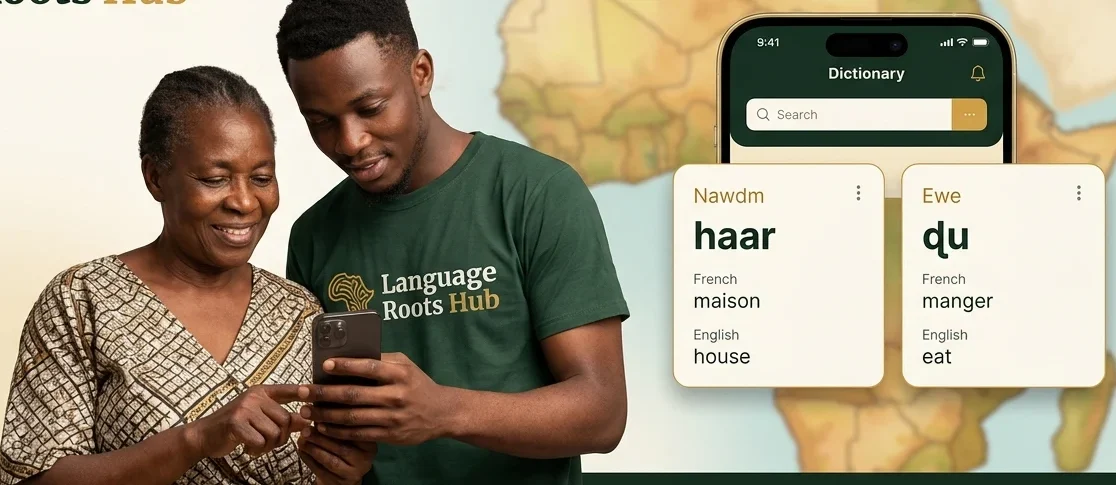
If you want to learn more Ewe words and phrases, our free Ewe Dictionary on Language Roots Hub gives you access to thousands of Ewe words with English and French translations. You can use it directly in your browser or install it on your phone for offline access.
Leave a Reply