They call their homeland Ewedome: the land of the Ewe. It stretches across the southeastern edge of Ghana, through the southern half of Togo, and into parts of Benin. The Ewe people number around five million, possibly more depending on which dialect communities you count. They are farmers and fishers, weavers and drummers. And the story of how they arrived where they are begins with a wall. Or more precisely, with an escape from behind one.
The Notsie Story
The origin story most widely shared among the Ewe points to a town called Notsie, in what is now central Togo. According to oral tradition, the Ewe lived there under a ruler named King Agokoli, who became increasingly cruel and oppressive. He surrounded the town with a wall so thick it could not be climbed or broken through. The people were trapped.
Their escape was planned carefully. The women began pouring water along one section of the wall night after night until the mud softened. When the wall weakened enough, the people broke through and scattered in different directions, eventually settling in what are now the Volta Region of Ghana, southern Togo, and parts of Benin.
The Hogbetsotso Festival, held on the first Saturday of November each year, is the Anlo-Ewe community’s celebration of that exodus. Chiefs arrive in full regalia. Drumming and dancing fill the streets. Libations are poured and histories are retold. It is a gathering that reminds the community of what its ancestors survived and how they chose to live afterwards.
Whether the story is literal history or shaped oral tradition matters less than what it means. The Ewe carry this narrative as a piece of their identity: they are people who broke out, who moved, and who rebuilt on the other side.
The Language
Ewe, known by its speakers as Ewegbe, belongs to the Gbe language cluster within the Kwa branch of the Niger-Congo family. It has around five million native speakers and holds official recognition as a national language in both Ghana and Togo.
Ewe is closely related to Fon (spoken widely in Benin), Gen, and several other Gbe languages of the coast. It has its own writing system and a body of literature that goes back to missionary translation work in the 1870s through the Volta Region.
Ewe is not a single, uniform language. The Anlo-Ewe spoken on Ghana’s southeastern coast differs in vocabulary and tone from the varieties spoken in Ho or Hohoe. Speakers of different varieties adjust to each other without much difficulty, but the differences are real and trace a map of where Ewe communities settled and how they developed independently across centuries.
To understand how the Ewe dictionary was assembled and what sources it draws from, see Building a Digital Dictionary for Ewe.
Weaving and Rhythm
The Ewe are well known for two things that require serious patience: cloth and drums.
The Ewe weave their own kente cloth, which is distinct from Ashanti kente in design and color meaning. While Ashanti kente tends toward gold and royal symbolism, Ewe kente favors geometric patterns that carry specific messages about family, community, and moral values. The weaving tradition is practiced across the Volta Region, and the town of Kpetoe holds an annual kente festival that draws weavers and buyers from across Ghana. A single piece of kente, woven on a narrow-strip loom, can take days to complete.
The drumming tradition is just as demanding. Ewe percussion ensembles are polyrhythmic, meaning multiple rhythms play simultaneously, each layer belonging to a different instrument, and the whole pattern only making sense when all of them are heard together. Music scholars have spent careers studying Ewe drumming because of how complex and internally structured it is. The Agbadza dance that accompanies these rhythms is widespread across Ewe communities and is still performed regularly at community gatherings and ceremonies.
How Ewe People Live
Most Ewe are farmers. Yams, corn, cassava, and plantain are staples depending on the area. In coastal communities, particularly among the Anlo-Ewe, fishing is a major occupation. The lagoons along Ghana’s southeastern coast and the Atlantic shoreline have fed Ewe communities for generations.
Family structure is patrilineal, meaning inheritance and lineage pass through the father’s line. The community places high value on collective identity over individual reputation. Individual profiteering is frowned upon, and communal effort is expected. Names given to children often carry the circumstances of their birth: the day of the week, a family event, or a spiritual meaning tied to the moment of arrival.
Ewe traditional religion, called Vodun, involves a range of deities, spirits, and ancestral forces. It is a sophisticated spiritual system rooted in a concern for community, moral accountability, and the relationship between the living and the dead. It is not the caricature version that Western popular culture has sometimes made of the word. Christianity is now the most widely practiced faith among the Ewe, but traditional spiritual practices continue to shape community ceremonies and family life.
A Language That Crosses Borders
Very few African languages cross as many national borders as Ewe does. Ewe speakers live in Ghana, Togo, Benin, and smaller communities in Nigeria. The German and British colonial divisions of the late nineteenth century drew lines through Ewe territory, separating families and communities that had been part of the same cultural world. The language survived those divisions and remains a common thread between Ewe communities across multiple countries.
That border-crossing identity also means Ewe has had to adapt to different official contexts. In Ghana, school instruction is mostly in English. In Togo, it is in French. Ewe speakers in both countries navigate between their mother tongue and an imported official language in ways that shape how the language evolves and who gets to use it formally.
Why a Dictionary Matters
Ewe has a stronger written and literary tradition than many African languages. It has been studied, documented, and taught in schools, particularly in the Volta Region of Ghana. That is a genuine advantage and means communities have solid reference materials to draw on.
What digital tools add is reach and convenience. A searchable, open-access dictionary removes the barriers of having to find a physical book, access a library, or pay for a subscription. As explored in Why So Many African Languages Are Missing From the Internet, even well-documented languages are underserved online.
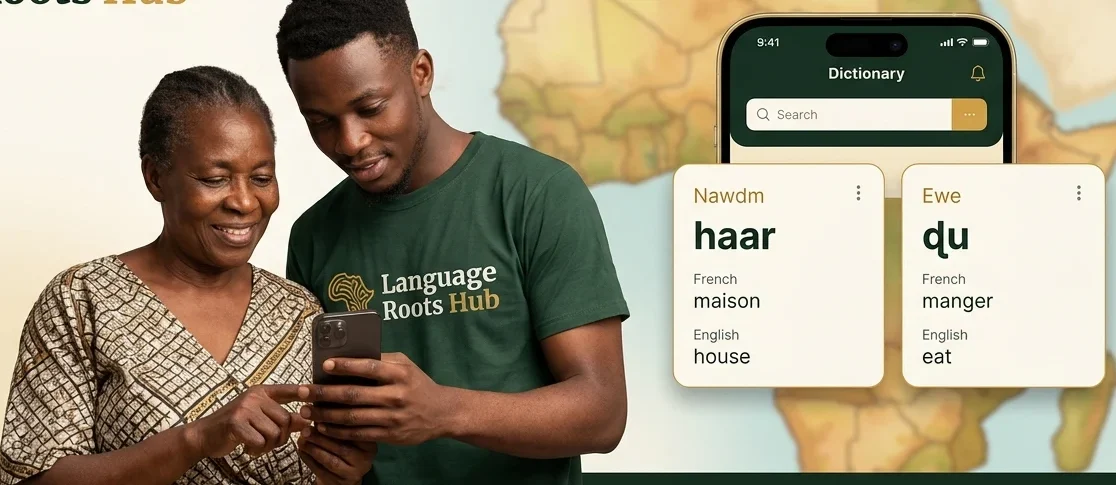
The Ewe dictionary on Language Roots Hub is free and open to anyone. If you are learning Ewe, or reconnecting with the language after time away from the community, Five Practical Tips for Learning a Language With No Textbook is a practical guide to getting started.
If you speak Ewe and find an entry that needs correcting or a word that is missing, feedback is welcome and helps make the resource better for everyone.
Sources: Wikipedia: Ewe language | Wikipedia: Ewe people | Britannica: Ewe | Face2Face Africa: History and Culture of the Ewe | Ghana Remembers: Ewe of the Volta Region
Leave a Reply