Africa is the most linguistically diverse continent on earth. Approximately 2,000 languages are spoken across the continent, representing roughly one third of all the world’s languages. Many of these languages are spoken by millions of people. Others are spoken by only a few thousand, or even a few hundred. And a growing number are on the verge of disappearing altogether.
UNESCO estimates that one language dies somewhere in the world approximately every two weeks. Africa accounts for a significant share of that loss. While some African languages are thriving and even expanding their reach, many others are losing speakers rapidly, with no written records, no digital presence, and no younger generation learning to use them fluently.
Understanding why this is happening, and what can be done about it, matters not just for linguists and scholars, but for everyone who values the richness of human knowledge and culture.
What Does It Mean for a Language to Die?
A language is considered endangered when it no longer has enough speakers to ensure it will be passed on naturally to the next generation. When a language dies, it does not just disappear as a means of communication. It takes with it an entire way of organizing and interpreting the world.
Languages encode knowledge that exists nowhere else. The names of plants, the techniques for farming particular soils, the stories that explain why certain things happen in nature, the philosophical concepts that have no equivalent in other languages, all of this is stored in the vocabulary, grammar, and oral traditions of a living language. When the language goes silent, much of that knowledge goes with it, often forever.
Why Are African Languages Disappearing?
Several forces are driving language loss across Africa. They rarely work alone. In most cases, multiple pressures combine to push a language toward extinction.
1. The Legacy of Colonial Language Policy
During the colonial era, European powers introduced policies across Africa that actively suppressed indigenous languages in schools, government, and public life. Children were punished for speaking their mother tongues in school. Official documents were produced exclusively in French, English, or Portuguese. The message was clear: African languages were inferior and belonged to the past.
Many of these policies were never fully reversed after independence. English remains the official language of Ghana. French is the official language of Togo, Côte d’Ivoire, and many other West African nations. Children grow up knowing that success in formal life, in education, business, and government, requires mastering a European language. This creates a generational shift away from indigenous languages, even when those languages are spoken at home.
2. Urbanization and Economic Migration
As people move from rural villages into cities, they often leave their language communities behind. In cities like Accra, Lomé, or Abidjan, multiple language groups live and work alongside each other. The practical need to communicate across language groups pushes people toward dominant regional languages (like Twi in Accra) or toward the official colonial language. Children raised in these multilingual urban environments may grow up speaking little or no of their parents’ minority language.
3. The Digital Divide
The internet and digital technology have become the primary spaces where languages live and grow in the modern world. Social media, messaging apps, entertainment, education, and business are all conducted primarily in a small number of globally dominant languages. When a language has no digital presence, no keyboard support, no voice assistant, no Wikipedia page, and no dictionary app, it becomes invisible to younger generations who spend much of their time online.
Many African minority languages have no digital footprint at all. This is not because the languages are unimportant, but because the resources to digitize them have not existed. The communities that speak them are often among the least economically resourced, and building digital tools requires money, time, and technical skills that have historically been concentrated elsewhere.
4. Prestige and Social Perception
Language death is often driven by perception as much as by policy or economics. When speakers of a language come to believe that their language is inferior, backward, or useless for getting ahead in life, they stop teaching it to their children. This is not a matter of shame in the simple sense. It is often a rational response to real social and economic pressures. If speaking Nawdm or Kabiyè offers no advantage in school or employment, while speaking French or English opens doors, parents naturally prioritize the language that will give their children the best opportunities.
Reversing this requires changing the social status of minority languages, demonstrating their value, and creating environments where speaking them is an advantage rather than a liability.
5. Small Speaker Populations
Some African languages were never spoken by large numbers of people. Languages like Nawdm, spoken primarily in the Savannah Region of northern Ghana and parts of Togo, or Kabiyè, spoken in northern Togo, have relatively small speaker populations. Small communities are more vulnerable to the pressures described above because they have fewer resources, fewer institutions, and less political influence to advocate for their language.
What Is Being Lost
Every language that disappears takes with it knowledge that has no equivalent anywhere else. African languages are particularly rich in vocabulary for local ecosystems, farming systems, medicinal plants, weather patterns, and social organization. Entire classification systems for plants, animals, and natural phenomena exist only in these languages. Traditional healing knowledge, passed down through generations in oral form, is encoded in vocabulary and narrative structures that cannot be straightforwardly translated.
Beyond practical knowledge, languages carry artistic traditions. The oral poetry, praise songs, riddles, proverbs, and folktales of any language are deeply shaped by the sounds, grammar, and cultural assumptions of that language. When translated, they lose something essential. When the language disappears, the original is gone entirely.
What Can Be Done
Digital Documentation and Dictionaries
One of the most practical steps in language preservation is creating a written and digital record of a language before it disappears. This means building dictionaries, recording spoken examples, transcribing oral literature, and making these resources accessible to speakers and learners. Digital tools are particularly important because they reach people where they are, on their phones and computers, in a format that younger generations use naturally.
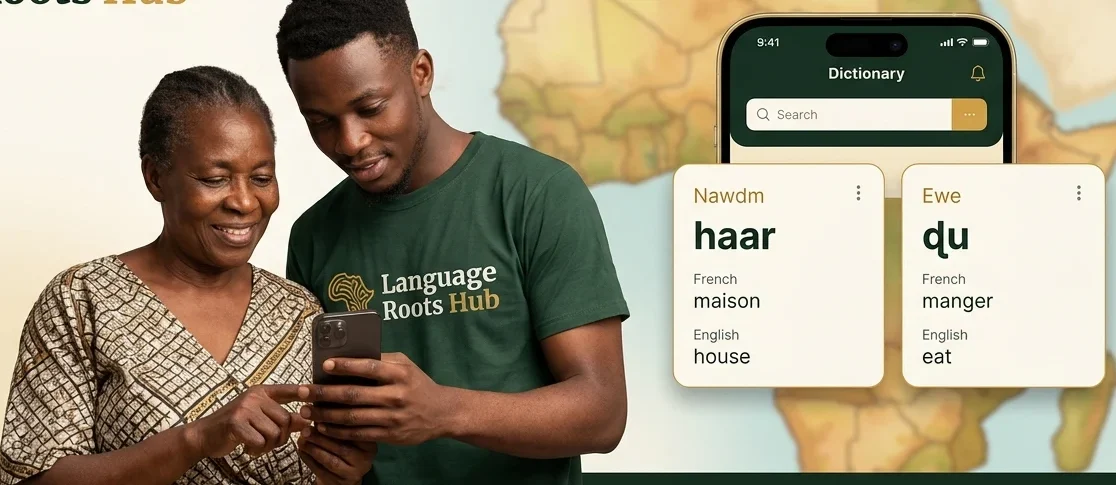
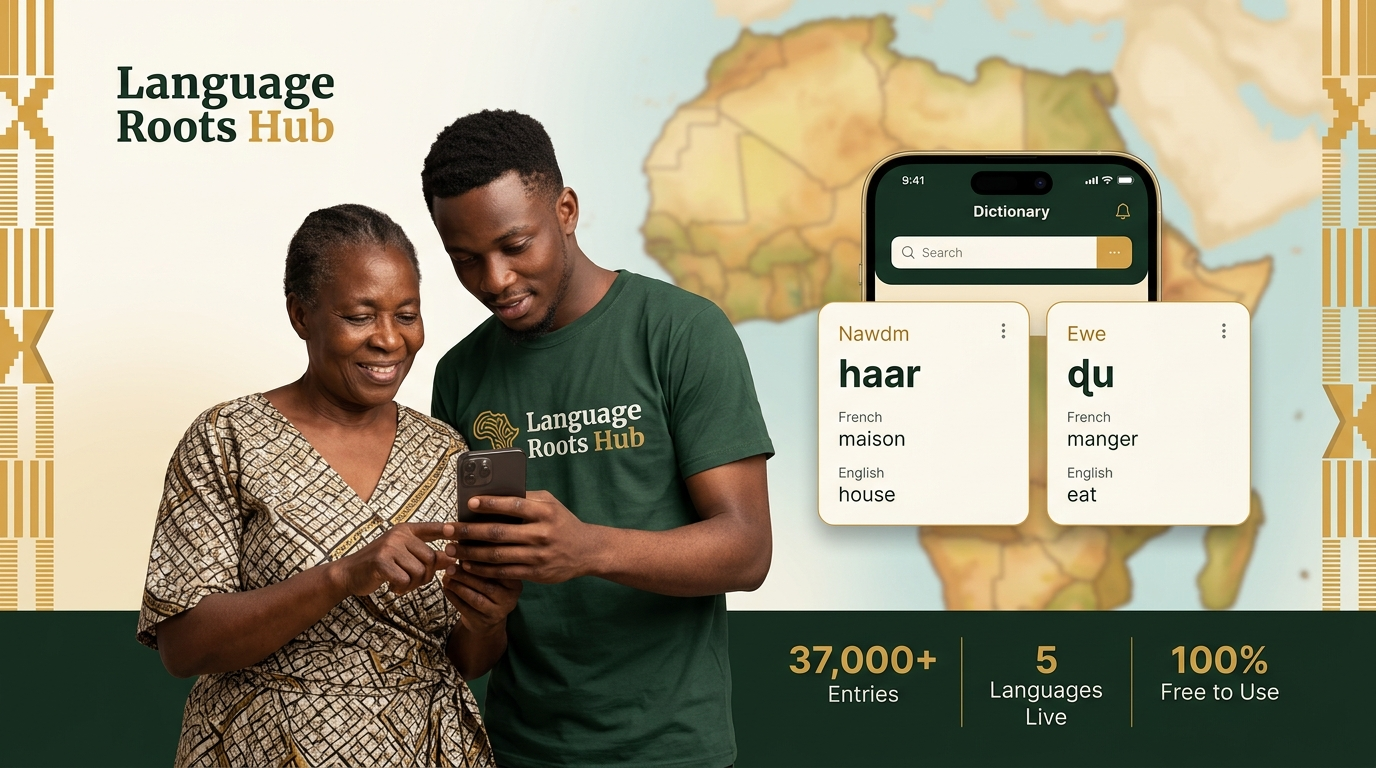
Projects like Language Roots Hub are doing exactly this for West African languages such as Nawdm, Ewe, Twi, Gã, and Kabiyè. By building free, searchable dictionary apps that work offline on mobile devices, these efforts put language resources directly into the hands of communities that need them.
Education Policy Reform
Several African countries have begun introducing mother tongue education in the early years of school, allowing children to learn to read and write in their first language before transitioning to the official language. Research consistently shows that children learn more effectively when taught in a language they already understand. Ghana’s curriculum has included provisions for mother tongue instruction in lower primary school, though implementation is across the country.
Community Language Programs
Communities themselves are often the most effective drivers of language preservation. When elders teach children, when proverbs and songs are passed on deliberately, when cultural events take place in the indigenous language, the language stays alive in a way that no government policy or digital tool can fully replace. Supporting community-led language programs, documentation projects, and cultural events is therefore one of the most direct investments in language survival.
Technology and Media
Creating content in African languages, whether written articles, YouTube videos, radio programs, or social media posts, helps normalize the use of those languages in modern life. When young people see their language used on digital platforms, it signals that the language belongs in the present, not just the past. Community radio stations in local languages have proven particularly effective in rural areas across West Africa.
The Urgency Is Real
Language loss is not a slow, gentle process. It can happen within one or two generations when social pressures are strong enough. A language spoken fluently by grandparents may be known only partially by parents, and hardly at all by children. Once that chain of transmission breaks, recovering the language becomes enormously difficult, even with good resources.
This is why the work matters now, not in ten years. The window for preserving many of these languages as living, spoken languages rather than archived records is closing within a generation in some cases. A dictionary built today, a story recorded this year, a child who learns to read in their mother tongue: these things are not symbolic gestures. They are the actual mechanism of survival for a language.
Explore African Language Resources
If you want to engage with some of the West African languages discussed in this article, Language Roots Hub offers free dictionary apps for Twi, Ewe, Nawdm, Kabiyè, and Gã. Each app is available online and can be installed on your phone for offline use. Visit languagerootshub.com to explore them.
Leave a Reply