
The Ga people are the indigenous community of what is now Ghana’s capital city, Accra. That fact alone sets them apart from most ethnic groups in West Africa. While urban growth has brought millions of people from every corner of Ghana into the city, the Ga remain the ones whose ancestors were here first, whose spiritual sites sit beneath the concrete, and whose language still carries the original name of a place now known across the world.
The name Accra itself comes from Nkran, a Ga word for the black ants whose mounds once dotted the coastal land. That one detail says a lot about how deeply Ga identity is tied to this specific piece of ground.
Origins and Migration
The Ga people are not originally coastal. Oral tradition holds that they migrated from the east, from what is now Nigeria, eventually settling along the coast and building themselves into a community of traders and fishermen. That migration brought them into contact with the Adangme, the Ewe, the Akan, and eventually with European traders who found the Gold Coast coast useful from the 1500s onward.
The Ga-Dangme grouping reflects a close historical relationship between the Ga and the Adangme, who share similar language roots and cultural patterns even though they are distinct peoples. Together they are counted among the Kwa language groups, placing them in the same broad Niger-Congo family as the Akan and the Ewe.
The Language
Ga belongs to the Kwa branch of the Niger-Congo language family. It is a tonal language, meaning the same word spoken at a different pitch can carry a completely different meaning. It follows a subject-verb-object structure similar to English, but has its own rhythms, idioms, and phonology that take time to learn properly.
Ga has its own writing system and a notable body of written literature, including a Bible translation that goes back to nineteenth-century missionary work. In everyday Accra, younger generations switch between Ga, Twi, and English depending on where they are and who they are speaking to. That kind of switching is not a sign of the language weakening. It is what happens when a language lives inside a megacity. Ga still anchors the things that matter most: the funeral rites, the festivals, the libations poured before food is shared, the words spoken when a child is named.
For a full account of how the Ga dictionary was built and the sources it draws from, see Building a Digital Dictionary for Ga.
Homowo: Hooting at Hunger
If there is one word that captures Ga culture for most Ghanaians, it is Homowo.
The name translates as “hooting at hunger,” and the story is direct: during the Ga people’s early settlement near the coast, a severe famine broke out. Crops failed, rains were scarce, and the community’s survival was genuinely uncertain. They planted anyway, waited through the dry period, and eventually the harvest came. Homowo is the annual act of remembering that hunger and celebrating the fact that it was beaten.
The festival runs from around August to September, with different Ga communities and quarters celebrating at staggered times according to traditional calendars. The centerpiece dish is kpokpoi, a steamed cornmeal preparation eaten with palm nut soup, sprinkled on the floor of the family house as an offering to the ancestors before the household eats together. Priests pour libations. Elders speak. People who have moved to other cities come home.
What makes Homowo unusual is how deliberately it keeps the doors open. Neighbors from other ethnic groups are welcome. The logic is simple: hunger was the shared enemy, and the feast belongs to anyone willing to show up.
How Ga People Live
Ga communities along the coast have historically combined farming with fishing. The sea has always been close. Many Ga families carry fishing in their ancestry even if they now work in offices, on building sites, or across the city in entirely different industries.
Ga kenkey, called wɔkpɛ or oto, is the community’s staple food. It is fermented corn dough wrapped and steamed in leaves, dense and slightly sour, usually eaten with fish stew, fried fish, or pepper sauce. It is different from Fante kenkey in preparation and taste, and Ga speakers will tell you the difference matters.
The Ga are also known for a craft tradition that has drawn international attention. The fantasy coffins of the Ga community, built in the shape of fish, cars, eagles, mobile phones, or whatever best represents the life of the deceased, are one of the most recognized art forms to come out of Ghana. They are not novelties. They reflect a belief that the dead should be sent off in a way that celebrates who they actually were, not just who they were expected to be.
The Kpanlogo dance is another cultural marker. It developed in the 1960s as a Ga youth expression, blending traditional rhythms with the energy of a city that was growing fast. It remains one of the most recognizable dances from the Greater Accra Region.
Faith and Community Life
The Ga traditional religious system centers on a supreme deity known as Nyonmo, alongside a range of minor deities and ancestral spirits that play roles in everyday and ceremonial life. The Kpele tradition involves songs, chants, and ritual practices that connect the community to its spiritual history. These practices continue alongside Christianity, which is now widely practiced across the Ga community.
Funerals are one of the most significant social events in Ga life. They are not quiet affairs. A Ga funeral is an extended community gathering with drumming, dancing, and all-night singing. They can last several days. The community comes together not just to grieve but to send the person off properly, which means loudly, with food, music, and the physical presence of as many people as can make it.
Why a Dictionary Matters
The Ga language lives inside one of West Africa’s fastest-growing urban environments. Every year Accra pulls in more people, and for young Ga children growing up in the city, English and Twi are often the default languages of school and street. Ga is spoken at home, in the family yard, at festivals, and in the moments that define who the community is. But that informal role is also a vulnerable one.
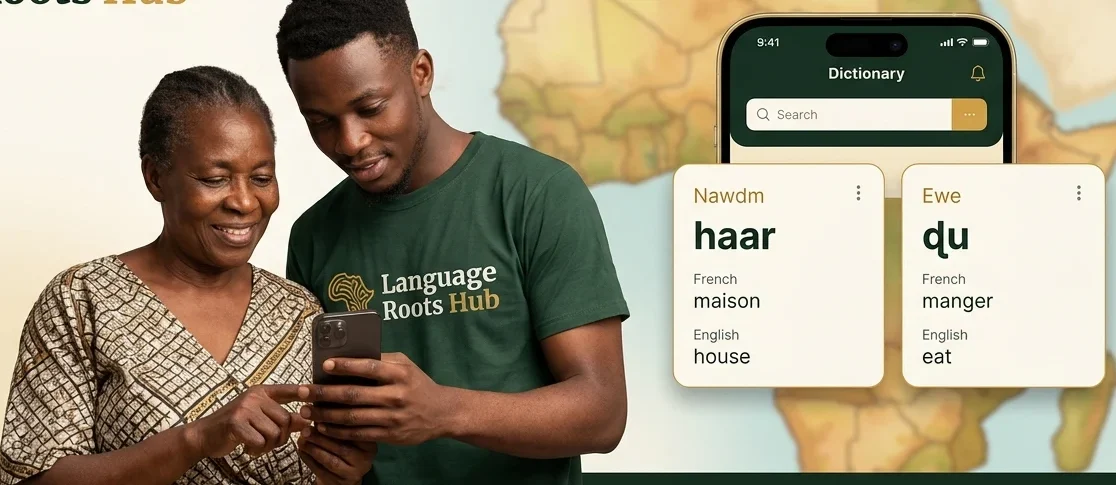
As we discussed in Why So Many African Languages Are Missing From the Internet, the gap between what languages exist and what languages get digital tools is real. The Ga dictionary on Language Roots Hub is one contribution to closing that gap: free, open, searchable, with no login required.
If you speak Ga and find an entry that needs correcting or expanding, that feedback is welcome. And if you are thinking about learning Ga, Five Practical Tips for Learning a Language With No Textbook is a useful starting point.
Sources: Wikipedia: Ga people | Wikipedia: Homowo | Visit Ghana: Homowo Festival | Ghana National Commission on Culture: Greater Accra | African Roots Travel: Origin of Homowo
Leave a Reply