If you spend even a week in Ghana, you will hear Twi everywhere. In tro-tros, in markets, in churches, in conversations between strangers who share no hometown. Twi is not just the language of the Ashanti, though the Ashanti are its most famous speakers. It is the de facto common language of southern and central Ghana, the one people reach for when they do not know what else to speak.
That reach comes from a long history of empire, trade, and cultural influence that has made the Akan people and their language the largest and most dominant cultural force in modern Ghana.
Who the Akan Are
The Akan are not one people but a cluster of related ethnic groups who share a language family, a matrilineal kinship system, and a broad cultural heritage. The major subgroups include the Ashanti, the Fante, the Akuapem, the Akyem, the Bono, the Kwahu, the Wassa, and others. Together they make up approximately 45 to 50 percent of Ghana’s total population, the largest single ethnic grouping in the country.
Twi refers specifically to the Ashanti and Akuapem varieties of the Akan language. Fante is closely related but distinct enough to count as its own variety. All sit within the Kwa branch of the Niger-Congo language family. Over 40 percent of Ghanaians speak an Akan variety as their mother tongue, and when you include second-language speakers, the number approaches 80 percent of the country’s population.
The Akan matrilineal system is unusual in Ghana and in West Africa more broadly. Property, inheritance, and chieftaincy titles pass through the mother’s line, not the father’s. A chief’s successor is typically his brother or his nephew through his sister, not his own son. This shapes how families are organized, how wealth is held, and how political authority is legitimized in ways that reach into every area of Akan life.
The Ashanti Empire
The Ashanti Empire, founded in 1701 and lasting until British conquest in 1901, is one of the most extensively documented African empires south of the Sahara. At its peak it extended across most of what is now Ghana and into parts of Côte d’Ivoire and Togo. The capital, Kumasi, was a significant city with markets, diplomatic connections, and a hierarchical governance structure that operated independently of any European system.
The empire was wealthy, largely because of gold. The Akan lands sit on some of the richest gold deposits in West Africa, and the trade in gold and later in slaves gave the empire resources that funded both its expansion and its resistance to outside control.
The symbol of Ashanti unity is the Golden Stool, known as Sika Dwa Kofi. The stool is held to contain the spirit of the Ashanti nation. Not even the Asantehene, the Ashanti king, sits on it. When British authorities in 1900 demanded that the Asantehene hand it over, the request triggered what became known as the War of the Golden Stool, one of the last armed resistances against British rule in Ghana. The British never captured the stool.
Kente, Adinkra, and the Weight of Symbols
The Akan contributed two of the most recognizable visual traditions to come out of Africa.
Kente cloth originated with the Ashanti, woven in narrow strips on a horizontal loom and sewn together into large cloths. Each pattern has a name and a meaning, often tied to a proverb or a moment in history. Kente was originally a royal fabric, worn by chiefs and at important ceremonies. It has since become a global symbol of African identity, worn by diaspora communities at graduations, cultural celebrations, and public statements of heritage.
Adinkra symbols are a parallel tradition: geometric motifs, each carrying a philosophical idea. Gye Nyame means “except God, I fear none.” Sankofa shows a bird looking backward and means “return and fetch it,” a statement about learning from the past. Dwennimmen, the ram’s horns, represents humility alongside strength. These symbols are stamped on cloth, carved into furniture and architecture, and used in logos and public design across Ghana.
Proverbs complete this tradition. Among the Akan, the ability to quote and apply proverbs well marks a person as educated and wise. Elders use them in speeches, in dispute resolution, and in teaching. The proverb “Okoto nwo anoma” (“A crab does not give birth to a bird”) speaks to family resemblance and the continuity of character across generations. These are not decorative sayings. They are a working system for communicating complex ideas quickly and memorably.
How Akan People Live
The majority of Akan people live in southern and central Ghana, across the Ashanti, Eastern, Central, Western, and Ahafo regions. Agriculture has historically been the primary occupation, with cocoa, yam, plantain, and cassava as major crops. The Ashanti Region is one of Ghana’s main cocoa-producing areas, and Akan farmers have been central to Ghana’s economy since cocoa farming spread in the late nineteenth century.
Traditional Akan food includes fufu, pounded from cassava and plantain into a smooth, dense ball eaten with groundnut soup, palm nut soup, or light soup. It is the meal Akan families make for important occasions and the dish most associated with Akan hospitality.
The Akwasidae Festival, held in Kumasi every six weeks, is one of the most visually striking public ceremonies in West Africa. The Asantehene appears in full regalia, surrounded by chiefs, drummers, horn-blowers, and state attendants carrying swords and ceremonial umbrellas. It is not staged for tourists. It is a functioning act of political legitimacy, a living institution of a kingdom that predates the Ghanaian state by two centuries.
Beyond Ashanti
It is easy to let the Ashanti empire story crowd out the rest of the Akan world. The Fante, who live primarily in the Central Region and along the coast, have their own distinct political history, including early resistance to both Ashanti expansion and British colonial rule. The Akuapem, in the Eastern Region, were among the first communities in Ghana to take up cocoa farming and to build strong relationships with missionary education. The Bono of the Brong-Ahafo area are considered the oldest Akan group. Each subgroup carries its own history, its own festivals, its own proverbs, and its own variations on the shared Akan cultural framework.
The Akan also produced two of the most globally recognized Ghanaians of the twentieth century: Kwame Nkrumah, Ghana’s first president and a founder of pan-Africanism, and Kofi Annan, who served as UN Secretary-General from 1997 to 2006. Both were Akan.
Why a Dictionary Matters
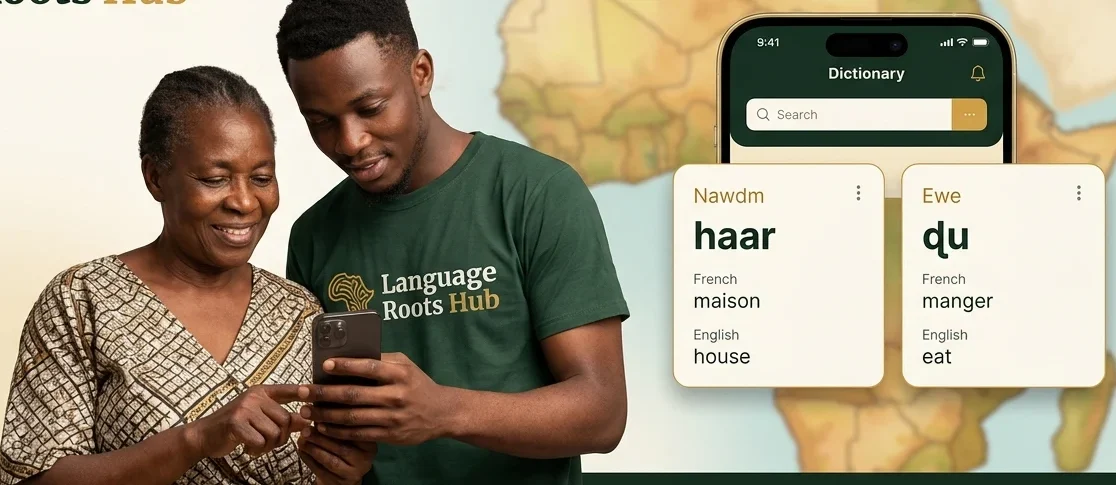
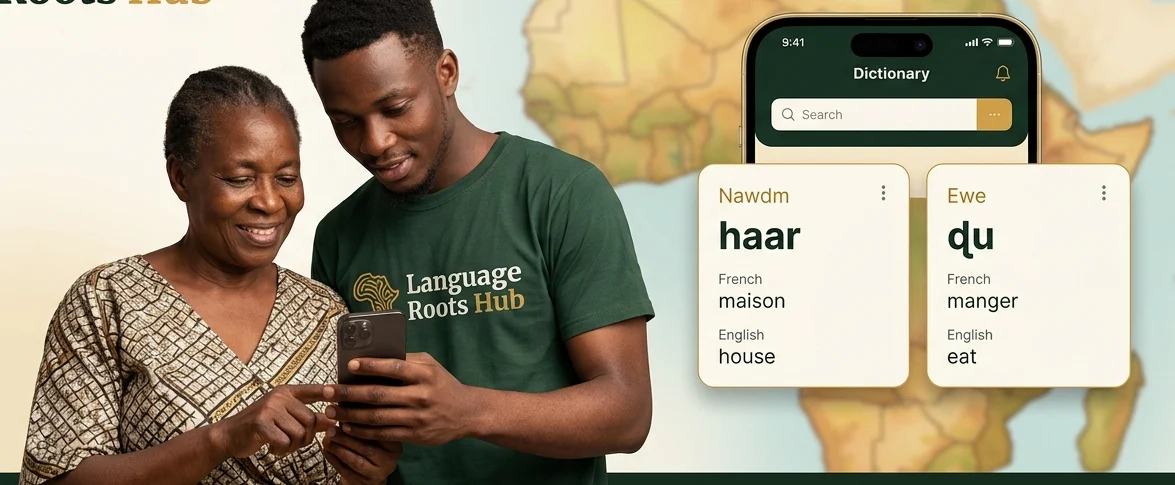
Twi is one of the stronger African languages in terms of digital resources. It has apps, YouTube channels, and learning platforms built around it, which is partly a product of Ghana’s size and the Ashanti diaspora’s reach. That is good. It also means the Twi dictionary on Language Roots Hub is entering a space where useful resources already exist.
What this dictionary contributes is open access and simplicity. No login, no paywall, no subscription. For learners, for children of the diaspora reconnecting with the language, or for researchers needing a free reference tool, that matters. For a look at how the dictionary was put together, see Building a Digital Dictionary for Twi (Akan).
As we explored in Why So Many African Languages Are Missing From the Internet, even widely spoken languages are underserved when it comes to free, accessible digital tools. And if you are starting to learn Twi, Five Practical Tips for Learning a Language With No Textbook offers a practical starting point.
Sources: Wikipedia: Akan people | Britannica: Asante | Ghana Citizenship: Who Are the Akan People | University of Alabama: Twi/Akan Language | Wikipedia: Ashanti Empire
Leave a Reply