In the highlands of northern Togo, between the Kabiyé Mountains to the south and the Défalé Chain to the north, a plateau stretches across the Doufelgou District. The people who call that plateau home call themselves the Nawdba. Their language is Nawdm. And the story of how they got there, at least the version they tell themselves, starts not from the east or the west, but from the sky.
 That origin story says a lot about the Nawdba. They claim no migration from a distant kingdom, no long march across the savanna. Their own formal tradition holds that the first Nawdba descended directly from above into two sacred forests, one in Koka and one in Siou. The first man arrived carrying a bow, arrows, and a hoe. The first woman carried the tools she needed for her own work. No ceremony, no waiting. Just two people, two forests, and a plateau to build a life on.
History is more complicated than tradition, of course. Many older Nawdba will tell you their people came from the east, from somewhere in the direction of Djougou in what is now Bénin. Linguists tend to side with the older people on this one. Nawdm is closely related to Yom, a language spoken near Djougou, and both sit within the Oti-Volta branch of the larger Gur language family. Gur itself belongs to the Niger-Congo family, one of the largest in the world. So the roots go deep and spread wide. But the home is here, in Doufelgou.
A Language with the Wrong Name
The Nawdba have had to fight for something most people take for granted: the right to be called what they actually call themselves.
For much of the colonial period and well after it, outsiders referred to this group and their language as “Losso” or “Losu.” The problem is that those names were never used by the Nawdba themselves. They were labels assigned by neighboring groups, lumping together the Nawdba and the Lamba, two distinct peoples who speak two completely different and mutually unintelligible languages. Using Losso to describe Nawdm speakers specifically is like calling someone by the wrong name and then refusing to correct yourself even after they have told you.
The correct name for the people is Nawdba (one person: Nawda). The correct name for their language is Nawdm. Linguists know it by ISO code nmz. There are around 190,000 speakers in Togo and another 8,000 in Ghana, where Nawdm communities exist today in the Greater Accra Region and the Oti Region.
The Plateau They Built On
The Doufelgou District sits in the Kara Region, and within it, five cantons form the traditional Nawdm heartland: Niamtougou, Koka, Baga, Ténéga, and Siou. Niamtougou is the district capital and its biggest market town. On a Sunday morning, the town square fills early. Before the preachers arrive, before the drummers set up, before the women balance their trays and head for their stalls, the place already has a pulse.
The Nawdba’s immediate neighbors are the Lamba to the north and west, and the Kabyè to the south and east. These groups have influenced each other across many generations. Songs, customs, and everyday expressions have passed back and forth across the borders of language and community. But influence is not the same as sameness. Nawdm, Lamba, and Kabyè are separate languages. A Nawda cannot simply walk into a Kabyè conversation and follow along.
How People Live
The Nawdba are farmers. That is not a generalization; it is the organizing fact of daily life on the plateau. Most households grow millet and sorghum, which get ground into a thick porridge called la pâte. La pâte appears at almost every meal. From the same grains, people also brew daam, a low-alcohol fermented drink with a thick, sour taste and a long history at community gatherings.
Beyond the staples, families grow peanuts, manioc, cotton, and palm, selling what they can at local markets. Men also work as blacksmiths, carpenters, masons, and tailors. Young men weave baskets and hats. Women have organized soap-making cooperatives. Young girls sell donuts at roadside stalls and help care for younger children. Everyone has something to do, and community life runs on the assumption that everyone will do their part.
Livestock fills out the picture. Chickens, guinea fowl, goats, pigs, and sheep move through most family compounds, providing both income and protein through the year.
The People Who Left
Here is something most outside accounts of the Nawdba leave out: the majority of them no longer live in Doufelgou.
Only about 25 percent of all Nawdba still live in the traditional homeland. The remaining 75 percent spread out, mostly in search of farmland and work, settling across central and southern Togo, on farms between Sokodé and Notsé, and in cities like Kara, Sokodé, and Lomé. A smaller number crossed into Ghana, where Nawdm communities have existed for generations, some going back to the era when young men took work in the cocoa plantations.
That diaspora matters for the language. When people scatter, the language scatters with them. A Nawdm speaker in Lomé who navigates French and Ewe every day uses Nawdm differently than someone in Niamtougou who barely needs anything else. Keeping Nawdm alive across all those different contexts is not an automatic process. It takes deliberate effort.
Songs, Drums, and Ceremony
The cultural life of the Nawdba is not something you observe from a distance and immediately understand. Ceremony and music run through the rhythms of daily and seasonal life in ways that take time to learn.
What even an outsider notices first is the sound. The tam-tam. The dum-dum drum. Flutes in the open air. Dancers with maracas tied to their ankles, moving in patterns that have been practiced and passed down for generations. At community gatherings, people from across the religious spectrum, Christians, Muslims, and those who hold to traditional practices, often gather in the same space, drawn together by the occasion rather than divided by belief.
There are also ceremonies that are harder to witness. The ritual practices of the Nawdba are serious cultural events with their own protocols, participants, and purposes. They are not performances staged for visitors. They are part of a living spiritual tradition that has coexisted, sometimes uneasily, with both Christianity and Islam for well over a century now.
The Word in Their Own Language
One moment in recent Nawdba history deserves more attention than it usually gets.
For a long time, church services across Togo were conducted in French, the country’s official language. That arrangement worked reasonably well for people who read French fluently. For the portion of the Nawdba community who communicate almost entirely in Nawdm, and who have had limited access to formal French schooling, it meant sitting through worship in a language they could not fully follow. The Bible, the prayers, the sermons, all of it arriving through a filter.
That changed when the New Testament and the Psalms were translated into Nawdm. The celebration at Niamtougou when the translation was launched drew around 300 people. Drums played. Songs went up in Nawdm. The regional minister of culture spoke. Christians, Muslims, and those from traditional backgrounds all showed up. One Nawda churchgoer said simply: “In our churches, we will directly hear the Word of God in our own language.”
That one sentence carries more weight than it might first seem. A language lives most fully when it can hold the things a community cares most about.
Why a Dictionary Matters
A language dictionary is not only a reference tool. It is also a record. It says: this language existed, these words belonged to real people, and these meanings were worth writing down.
Nawdm has around 198,000 speakers across Togo and Ghana. It has a literary tradition, a New Testament, and a linguistic history going back to serious academic study in the mid-20th century. It is not a dying language by any measure. But it is also not one of the languages that gets automatic resources, automatic funding, or automatic attention from the wider world. As we explored in Why So Many African Languages Are Missing From the Internet, the gap between what languages exist and what languages get digital tools is wide.
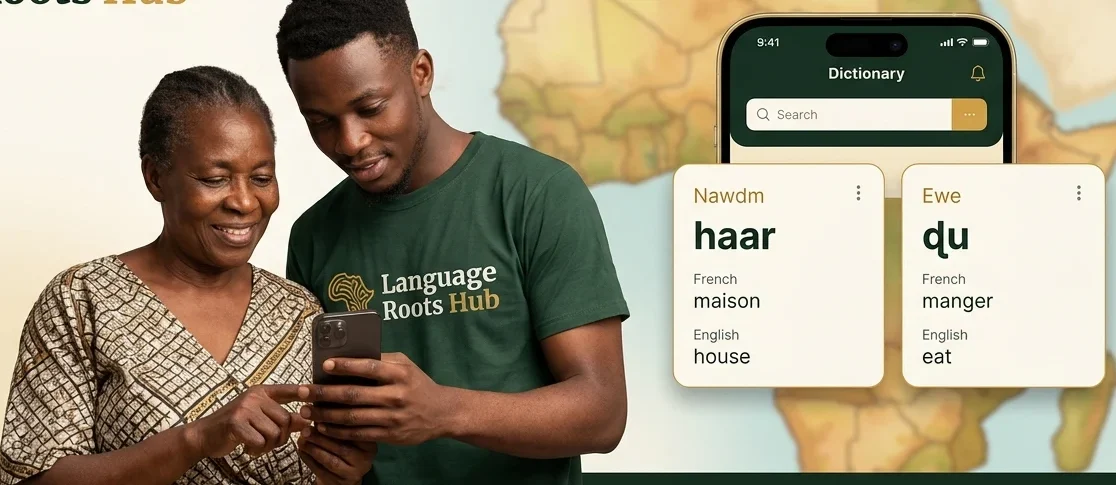
The Nawdm dictionary on Language Roots Hub is a contribution to closing that gap, one entry at a time. For a full account of how it was put together, see Inside the Nawdm Dictionary. And if you are thinking about learning Nawdm yourself, Five Practical Tips for Learning a Language With No Textbook is a useful starting point.
If you speak Nawdm and find a word missing, a meaning that is not quite right, or a pronunciation that needs correcting, that feedback matters. The goal is a resource that the Nawdba community actually trusts and uses, not just one that exists.
Sources: Wikipedia: Nawdm language | Wikipedia: Losso people (Nawdba) | Webonary Nawdm Dictionary Introduction | Joshua Project: Nawdm in Togo | MiDi Bible: Nawdm New Testament
Leave a Reply