Nawdm is a living language with a history that stretches back through the highlands of northern Togo and into a long tradition of migration, settlement, and community resilience. Before the Nawdm dictionary project under Language Roots Hub, a fully searchable digital dictionary for Nawdm in English and French simply did not exist. This article is a complete introduction to the language, its people, and the linguistic features that make it distinct.
Origins and Geographic Spread
Nawdm is the language of the Nawdba people. It originates from the northern part of Togo, in the area around the Doufelgou District and the broader Kara region. The Nawdba established their communities in the highlands of that area over many generations, living in a landscape shaped by the Kabiyè Mountains to the south and the plateau stretching across the northern Volta basin.
Over time, significant numbers of Nawdm-speaking people migrated and crossed into Ghana. Today, communities of Nawdm speakers live in the Greater Accra Region of Ghana, particularly in and around the capital city, as well as in the Oti Region, which was formerly part of the Volta Region. This means Nawdm is a language that crosses national borders, carried not by political decision but by the movement of families and communities over generations. It is spoken in two countries and in urban as well as rural settings.
Language Family
Nawdm belongs to the Gur branch of the Niger-Congo language family. Gur languages are found primarily in the inland savanna zones of West Africa, including Burkina Faso, northern Ghana, northern Togo, and northern Benin. Within this group, Nawdm shares structural features with languages like Kabiyè, Dagbani, and Mooré, including a tonal system in which pitch changes meaning, and a noun class structure that organises vocabulary in ways that differ significantly from European language patterns.
The Tonal Nature of Nawdm
Like all Gur languages, Nawdm is tonal. This is one of the first things a learner coming from a non-tonal language background will need to understand. In Nawdm, the same sequence of consonants and vowels can mean entirely different things depending on whether the syllable is spoken with a high tone, a low tone, or a falling or rising pitch. This is not a complication layered on top of the language. It is a fundamental part of how the language works.
Tonal languages are not more complex than non-tonal ones. They are simply organised differently. For speakers who grew up with Nawdm, the tonal distinctions are as natural and automatic as any other feature of speech. Learners approaching the language from outside need time to train their ears, but the patterns are consistent and learnable.
The Written Form of Nawdm
Nawdm can be written using the Latin alphabet with some additional characters to represent sounds that do not occur in European languages. An established orthography has been developed through linguistic research and community engagement over the years. The Nawdm dictionary on Language Roots Hub uses this written form, making it searchable and readable for anyone who wants to engage with the language in its written shape.
Having a written form is significant for any language community. It makes the language teachable in formal settings, preservable in documents and records, and accessible to diaspora members and researchers who want to engage with it from a distance.
The Community Today
The Nawdba community spans northern Togo and southern Ghana, with the Greater Accra Region being the most significant point of settlement in Ghana. In Accra, Nawdm speakers maintain their language and cultural identity within a city that is home to dozens of language communities from across Ghana and beyond. The Oti Region also has established Nawdba communities that have maintained the language across generations since the original migration.
In Togo, the language is part of the broader cultural fabric of the Kara Region, where it exists alongside Kabiyè and other northern Togolese languages. Community use of the language in everyday life, in family settings, religious gatherings, and cultural events, remains the primary means by which it is passed on to younger generations.
The Nawdm Dictionary
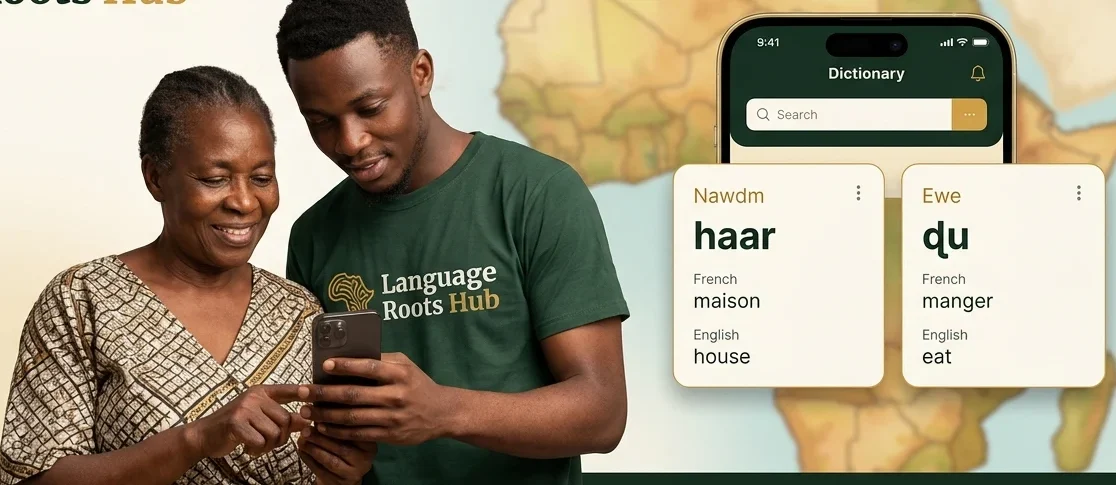
The Nawdm dictionary, the first project built under Language Roots Hub, contains over eleven thousand searchable entries across Nawdm, French, and English. It is free to use and works offline once the app is installed on a device. It was built from a combination of published reference material, community word lists, and careful personal review of every single entry. Visit the Nawdm dictionary page to open the dictionary.
Leave a Reply