In schools, on social media, in family conversations about what language children should grow up hearing: African communities are making deliberate choices to reclaim their mother tongues. This is not a trend driven by nostalgia. It is driven by a clear-eyed understanding of what colonialism did to the relationship between language and power, and what that cost looks like now, a generation or two later.
The Colonial Legacy of Language
When European powers colonised the African continent, they did not only take land and resources. They restructured the relationship between language and power. Education was conducted in the coloniser’s language. Advancement in official life depended on fluency in French, English, Portuguese, or other colonial languages. The practical incentive to speak the dominant language was enormous: access to education, government, formal employment, and social mobility all flowed through the colonial language.
African languages were not banned in all contexts, but they were systematically pushed to the margins of formal life. They became associated with home, with rural areas, with the “traditional” rather than the “modern.” For several generations, many African families made a calculated decision to invest in the colonial language at the expense of the mother tongue. The reasoning was understandable given the pressures of the time. But the cost, accumulated across generations, is now clearly visible.
What Is Being Lost
A language carries far more than vocabulary. It carries a way of categorising the world: a system of relationships and values encoded in how words relate to each other, proverbs and oral literature that have no equivalent in any other language, a sense of who a community is and where it comes from. When a language goes silent, that entire world goes with it.
Linguists estimate that roughly half of the world’s languages are at risk of disappearing within this century, and African languages make up a significant portion of that figure. Many have already been lost. Others survive only among elderly speakers with no younger generation following them into the language. The loss is not only cultural. It is a reduction in the actual range of ways human beings have found to understand and talk about the world. That is not recoverable once it is gone.
Why Reclamation Is Happening Now
Several things have come together to create the current moment. The first is a generation of Africans who grew up with the colonial language as their dominant one but who feel something missing in that arrangement. They can operate fluently in English or French, but they cannot speak to their grandparents in the grandparent’s first language. That gap is felt personally, not just politically.
The second is digital technology. Social media has created spaces where African languages appear in text for the first time for many speakers. Young people post in Twi, Ewe, Yoruba, Swahili, or Wolof and discover that large communities are doing the same. YouTube channels teach African languages to diaspora members. WhatsApp groups conduct conversations in languages that, a generation ago, rarely appeared in written form at all. The digital space has given these languages a new kind of visibility and a new kind of legitimacy.
The third is a shifting cultural and political consciousness. Growing pride in African identity across the continent and in diaspora communities has made mother tongue reclamation feel like progress rather than nostalgia. Speaking your mother tongue is no longer seen as something that holds you back from the modern world. Increasingly, it is the opposite: a sign of where you come from, and something worth holding onto.
What Communities Are Actually Doing
Reclamation takes many forms. Some communities are pushing for mother tongue education in primary schools, recognising that children learn better in a language they already understand at home. Others are producing written literature, music, and digital content in African languages, building a body of modern material that makes the language feel alive and relevant to younger people.
Language documentation projects are recording oral traditions, vocabulary, and grammatical knowledge from elder speakers before that knowledge is lost. Diaspora communities in Europe and North America are organising language classes for children who were born outside Africa and may not have grown up hearing their heritage language at home.
What Dictionaries Contribute
A dictionary is one of the foundational tools a language community needs to maintain and grow its language in the modern world. It makes the language searchable. It makes it learnable for those who were not raised in it. It gives the language a presence in digital space and says, clearly and publicly, that this language has a vocabulary worth recording, worth searching, and worth teaching.
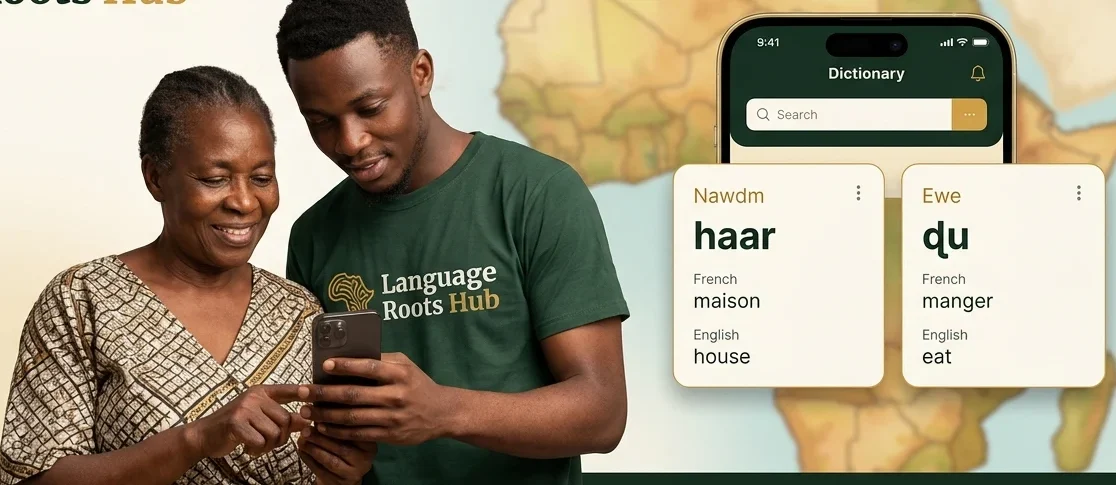
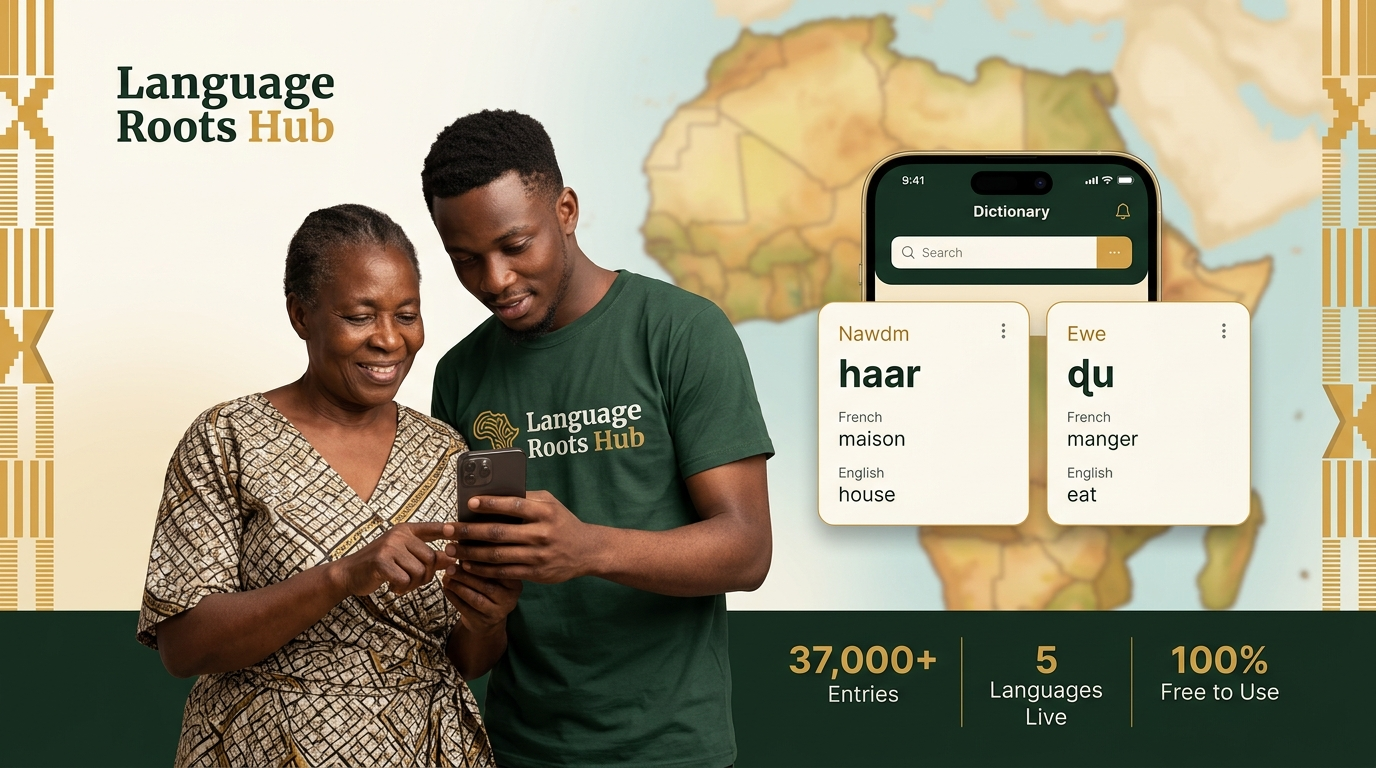
Language Roots Hub is one small part of a much wider movement. There are researchers, community organisations, and individual speakers across Africa doing similar work in hundreds of languages. Our contribution is a careful one, offered freely to anyone who wants it, in the hope that it makes the languages of the Nawdba, Kabiyè, Ewe, Akan, and Ga communities a little more accessible and a little harder to lose. Read more about the project.
Leave a Reply