Among the Ewe-speaking peoples of Ghana, Togo, and Benin, proverbs are not decorative language. They are a working tool. The tradition of Ewe proverbs, known in the language as lododowo, is one of the oldest and most developed oral traditions in West Africa. To know a proverb in Ewe is to understand something about how the community reasons, what it considers worth saying, and how it passes judgment without pointing fingers directly.
What a Proverb Does in Ewe Culture
Ewe proverbs are not decorative. They are functional. In traditional Ewe society, a proverb used at the right moment in conversation carries more persuasive authority than a direct argument. Elders use them in settling disputes. Parents use them in teaching their children. Community leaders draw on them in speeches and counsel. When someone speaks a proverb and it lands correctly, the room recognises its truth not because it has been logically proven but because it has been felt.
This is one of the defining features of West African oral tradition more broadly. In this context, language is not primarily a system for exchanging information. It is how a community stores what it knows, and proverbs are one of the most efficient storage formats: compact, memorable, and layered enough that the meaning changes depending on who says them and when. A proverb can say in eight words what would take a paragraph to explain directly, and it does so in a way that stays with the listener long after the conversation has ended.
The Structure and Sources of Ewe Proverbs
Ewe proverbs typically work through comparison, observation of nature, or reference to human relationships and community life. Many draw on the natural world: animals, water, fire, and the seasons. Others refer to farming, fishing, family dynamics, or the body and its senses.
One well-documented example of a lododowo is: Ati ɖeka me wɔ na ave o, meaning a single tree cannot make a forest. This proverb reflects communal values that run deep in Ewe society: the understanding that no individual, however strong or prominent, can constitute a whole community alone. Another example is Akpa le tome gake menya tsi fe vevie nyenyeo, meaning a fish is in water but does not know the importance of water. It speaks to how we often overlook the value of what surrounds and sustains us until it is gone.
The natural world features so prominently in lododowo because the communities that developed this tradition lived in close relationship with the landscape of the Volta Basin: its rivers, its forests, its farming cycles, and its animal life. The proverbs are, in part, a record of how deeply that relationship shaped the way the community thought and spoke.
The Tonal Quality of Ewe Wisdom
Part of what gives Ewe proverbs their force is the language itself. Ewe is a tonal language with a rich phonological system that allows for a kind of compact poetic effect in short utterances that is very difficult to reproduce in a non-tonal language. A proverb that takes a handful of Ewe syllables might require a full English sentence to convey, and in that translation something of the rhythm, the sound, and the snap is always lost.
This is why listening matters so much in this tradition. The proverb is not just a piece of text. It is a spoken performance, shaped by tone, timing, and the relationship between the speaker and the listener. Written forms of Ewe proverbs are valuable for preservation, but they capture only part of the original.
Oral Tradition and Language Preservation
The lododowo tradition faces the same pressures affecting oral traditions in urban contexts everywhere: written and digital media, multilingual environments, and the pace of modern life. Younger Ewe speakers growing up in cities like Accra, Lomé, or Cotonou may have limited exposure to the proverb tradition if their families have moved far from the rural settings where elders still regularly use this form of speech.
This is part of why documenting Ewe vocabulary and building digital access to the language matters. A proverb cannot be looked up in a dictionary the same way a single word can. But a person who has built enough Ewe vocabulary to understand spoken Ewe is a person who is capable of entering that tradition, of recognising a proverb when they hear one and beginning to understand what it means. The dictionary is a starting point. What lies beyond it, in the proverbs, the songs, and the conversations of Ewe speakers, is something that only grows more accessible as your vocabulary does.
The Living Tradition
Despite the pressures, the lododowo tradition is not dead. It is carried by elders, by rural communities, by storytellers, by musicians who embed proverb-wisdom into modern Ewe songs, and by families who still gather around the spoken word in the way their grandparents did. Every generation that passes the tradition on, even partially, keeps the possibility of its full recovery alive.
Explore the Ewe Language
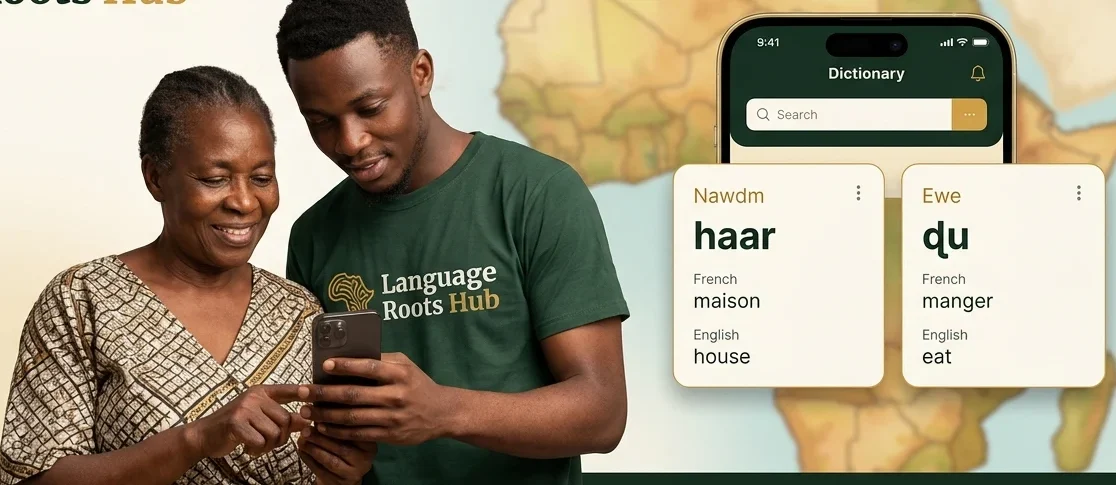
Language Roots Hub’s Nyagbalẽ dictionary gives you free access to thousands of Ewe words in English and French. It is a starting point for anyone who wants to understand the language behind the proverbs, the songs, the ceremonies, and the daily conversations of the Ewe-speaking world. Visit the Ewe dictionary page to begin.
Leave a Reply