Inside the Nawdm Dictionary
Nawdm is spoken in northern Togo and in parts of Ghana, including the Greater Accra Region and the Oti Region. Like many languages in that part of West Africa, it had no widely available digital dictionary until now. Here is a look at what actually went into building one.
Starting with what already existed
Rather than starting from nothing, the project began with existing reference material from SIL, word lists compiled over years, a published Nawdm-French dictionary, and community documents covering everyday vocabulary, farming tools, family relationships, and religious life. Pulling all of that into one consistent format was the first real task, and it was not a small one. Different sources spelled words differently, organized entries differently, and covered different ground. Before a single translation decision was made, just agreeing on which form of a word to treat as the main entry took real effort. Some terms appeared in three sources with three different spellings, all of them legitimate in some context.
Filling the gaps between languages
Most of the original material paired Nawdm with French, which made historical sense given Togo’s colonial and post-colonial language context. But that left a real gap for English-speaking learners, for researchers working outside the Francophone world, and for members of the Nawdm community in Ghana or in the diaspora who are more comfortable in English than French. Filling that gap meant adding English translations across thousands of entries, carefully enough that the actual meaning came through rather than just the nearest approximate word. Nawdm has vocabulary for relationships, farming practices, and communal life that does not map cleanly to English or French equivalents. In those cases, a direct translation is less useful than a short explanation of what the word actually means in its cultural context. That kind of decision had to be made entry by entry.
Turning a spreadsheet into something searchable
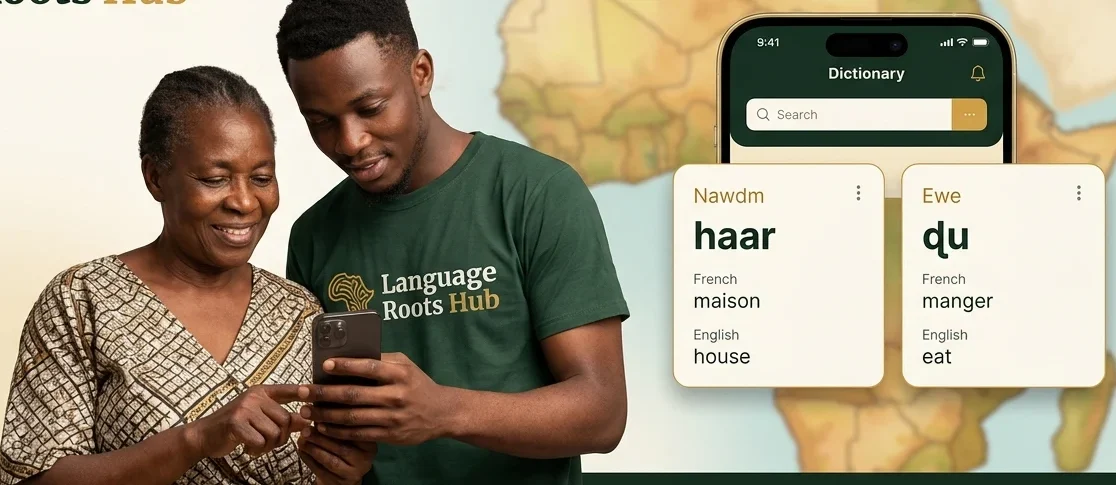
A well-organized list of words is useful, but it is not yet a tool anyone can actually use day to day. Making it real meant building an actual search experience, one that works whether someone types a word in Nawdm, French, or English, that groups entries by category for browsing, and that works fully offline. Reliable internet access is not something every user of this dictionary can count on. A tool that only works with a strong connection is one that excludes the very communities it is meant to serve. Getting the search right also meant handling Nawdm’s tonal and phonetic features carefully, so that someone who does not know the exact spelling can still find what they are looking for. A dictionary that only returns results for perfect spelling is not useful to a learner. The goal was a search experience that meets people where they are, not where the data is tidiest.
A living project, not a finished one
The Nawdm dictionary currently holds over twelve thousand words, and the number keeps growing. Anyone using the app can suggest a word that is missing, which gets reviewed before being added. That means the dictionary improves through direct input from Nawdm speakers, not just from researchers trying to document the language from a distance. That is a deliberate choice. A language dictionary compiled by outsiders and handed over as a finished product is a very different thing from one built in ongoing conversation with the people who speak it. The first kind is a snapshot. The second kind is alive. The goal has always been the second kind, and the suggestion feature is one of the ways that goal is built into the tool itself.
Leave a Reply