
Kabiyè is spoken primarily in the Kara region of northern Togo and has a notable community of speakers in Ghana as well. With over a million speakers across West Africa, it holds the status of a national language in Togo, used in schools, radio broadcasts, and daily life. Yet finding it in any practical digital form has historically meant working through academic archives or scanned documents that were never designed for everyday use. Here is a look at what actually went into building one.
Starting with what already existed
The main reference source was a bilingual Kabiyè-French dictionary compiled by SIL in 1999, a serious piece of scholarly work that had simply never made the jump to a digital, searchable format. Extracting those entries turned out to be one of the more technically demanding parts of the whole project. The original document used a legacy font encoding that predated Unicode, which meant that special Kabiyè letters like ŋ and ɣ were stored as mismatched characters that looked right on screen in the original font but became unreadable gibberish when copied or processed elsewhere. Each of those characters had to be remapped individually before any of the content could be reliably used. That work alone, before a single translation or formatting decision was made, took considerable effort to get right.
Filling the gaps between languages
Like a lot of linguistic documentation from that part of West Africa, the original material was paired with French, which made historical sense given Togo’s colonial and post-colonial language context. But it left a real gap for English-speaking learners, for researchers working outside the Francophone world, and for members of the Kabiyè community living in Ghana or in the diaspora who are more comfortable in English than French. Filling that gap meant adding English translations across close to nine thousand entries, carefully enough that the actual meaning came through rather than just the nearest approximate word.
Turning a collection of entries into something searchable
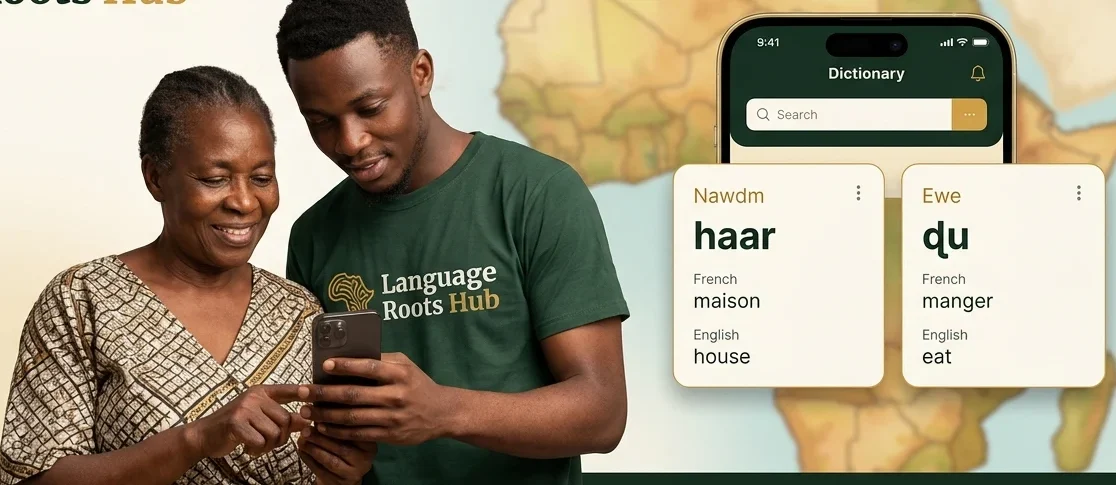
A well-organized list of words is a reference document. What this project set out to build was a tool people could actually use day to day. That meant putting a real search experience on top of the data, one that works whether someone types a word in Kabiyè, French, or English, that handles the tonal marks and special characters that are part of accurate Kabiyè spelling, and that functions fully offline. Reliable internet access is not something every user can count on, and a dictionary that only works with a strong connection is a dictionary that fails the people who need it most.
The app also includes a community verification layer for entries where the distinction between similar-sounding letters was not fully resolved during the initial build. Users can flag those entries so that native speakers can review and correct them over time, building accuracy into the process rather than pretending the first version was complete.
A living project, not a finished one
The dictionary currently holds close to nine thousand entries, and the number keeps growing. Anyone using the app can suggest a word that is missing, which gets reviewed before being added. That means the dictionary improves through direct input from the people who speak Kabiyè, not just from outside researchers trying to document it from a distance. A language resource built in that kind of ongoing conversation with the community is a fundamentally different thing from one that is compiled, handed over, and left to sit.
Leave a Reply