
Ga is the language of the Ga people, the indigenous community of what is now the Greater Accra Region of Ghana. As Accra has grown into one of West Africa’s major cities and one of the continent’s busiest urban centres, Ga has remained the historical and cultural language of the land, spoken by hundreds of thousands of people in and around the capital. Yet for most of its history, finding Ga vocabulary in any structured digital format meant knowing exactly where to look and having access to academic resources that most speakers never had. Here is a look at what actually went into building something more accessible.
Starting with what already existed
The most authoritative existing reference is the Kropp Dakubu Ga-English Dictionary, a substantial scholarly work that represents decades of careful linguistic documentation. Alongside that, materials from the Bureau of Ghana Languages and word lists maintained by communities online provided additional coverage. Pulling these sources together into one consistent dataset meant reconciling real differences in how words were spelled and how entries were organized, since each source had built up its own conventions over time and none of them were designed to be combined with the others. That reconciliation process, deciding which form of a word to treat as the main entry and how to handle variation across sources, was one of the first and most time-consuming parts of the whole project.
Filling the gaps between sources
Ga sits in a somewhat different position from some of the other languages in this project because Ghana is an English-speaking country, meaning there was already some English documentation to build on. The main work here was less about bridging a language gap and more about completeness. The goal was to make sure the full range of the language was covered, not just the vocabulary that earlier researchers happened to prioritize, but also the terms used in traditional ceremonies, the vocabulary of family and community life, trade language, and the kinds of everyday words that rarely make it into formal academic dictionaries but are the ones people actually need when they are trying to use the resource.
Turning a collection of entries into something searchable
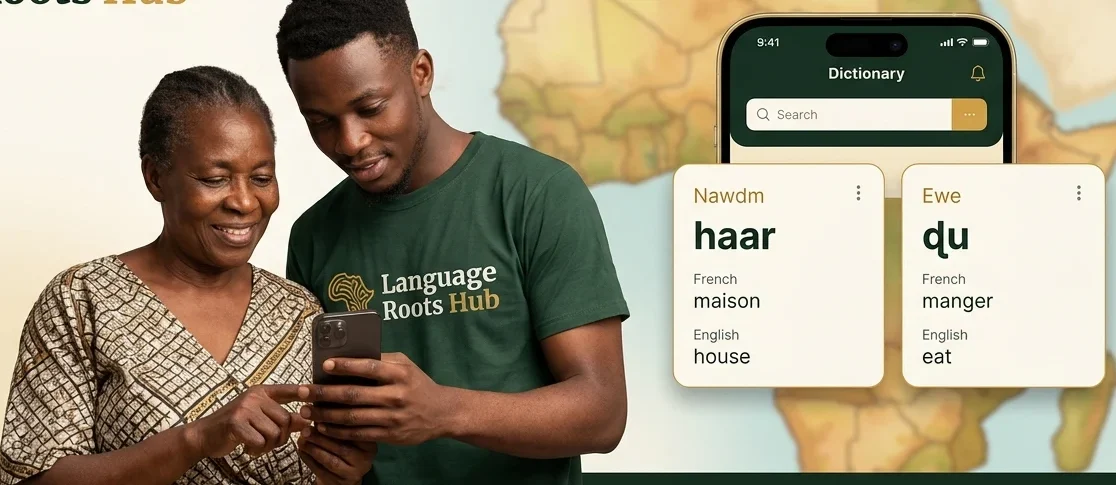
A compiled reference document is useful for scholars. A searchable app is useful for everyone else. Building that search experience meant handling Ga’s tonal and phonetic features properly, so that a user who types a word in Ga or in English can find what they are looking for without needing to know the exact spelling variant used in a particular source. The app works offline as well, because consistent internet access is not universal even in a city like Accra, and a tool that only functions with a strong connection is one that excludes the people who need it most.
A living project, not a finished one
The dictionary continues to grow as more entries are added and as users flag words that are missing or suggest corrections to what is already there. Every suggestion goes through a review process before being added, which means the dictionary improves through input from actual Ga speakers rather than relying only on what was captured in historical sources. For a language as tied to place and community as Ga, that kind of ongoing participation is not just a feature. It is the whole point.
Leave a Reply