Kwa is one of the major branches of the Niger-Congo language family, running along the coastal and forest belt of West Africa from Côte d’Ivoire through Ghana and Togo to Benin. Three of the languages covered on this site, Twi, Ewe, and Ga, all belong to this branch, which makes Kwa the most represented family here even though the site also covers two Gur languages, Nawdm and Kabiyè, from further inland.
Where Kwa Languages Are Spoken
Kwa languages sit in the coastal and forest zones of West Africa, in contrast to the Gur languages, which developed further north in the savanna. This geographic split, covered in more depth in our Gur and Kwa families article, roughly follows the line between forest and savanna that has shaped settlement, farming, and trade across the region for centuries.
The Main Kwa Language Groups
Kwa is not one language but a cluster of related groups. The three most relevant here are:
The Tano group, which includes Akan (commonly known as Twi, alongside its Fante and Akuapem varieties), Anyi, Baule, and Nzema. These languages are spoken mainly in Ghana and eastern Côte d’Ivoire.
The Ga-Dangme group, made up of Ga and its close relative Dangme, both concentrated in Ghana’s Greater Accra Region.
The Gbe cluster, which includes Ewe as well as Fon, spoken across the border in Benin. Ewe and Fon are close enough that speakers with exposure to both often understand each other to a real degree.
A Common Mix-Up: Yoruba and Igbo
Older classifications of African languages, dating back to Joseph Greenberg’s influential work in the 1960s, grouped Yoruba and Igbo under the Kwa umbrella alongside languages like Twi and Ewe. Most linguists today no longer classify them that way. Since a major revision of Niger-Congo classification around 1989, Yoruba, Igbo, and their relatives have been placed in a separate branch usually called Volta-Niger, distinct from the narrower Kwa grouping used here. If you came looking for Yoruba or Igbo under a “Kwa languages” search, this is why you won’t find them grouped with Twi and Ewe in current linguistic scholarship, even though they share the same broader Niger-Congo ancestry.
What Kwa Languages Have in Common
Despite their differences, Kwa languages share a handful of features that mark them as relatives. Most are tonal, meaning pitch changes the meaning of a word, a trait Twi, Ewe, and Ga all display. Most also follow a subject-verb-object word order and make heavy use of serial verb constructions, stringing together multiple verbs in a single clause to express what English would usually split into separate sentences with connecting words.
Kwa Languages on This Site
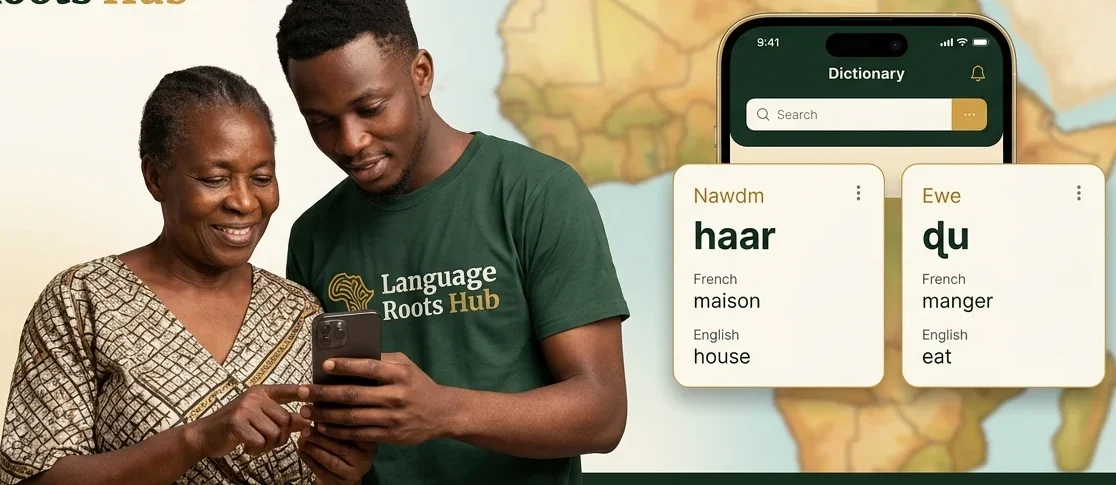
Language Roots Hub covers three Kwa languages in depth: Twi, Ewe, and Ga, each with its own dictionary and phrasebook. Alongside Nawdm and Kabiyè from the Gur branch, that gives the project a genuinely wide window into two of the most significant language traditions in West Africa. Read more about the project on the About page.
Leave a Reply