A comprehensive linguistic and historical article for language researchers, students, educators and African language enthusiasts.
Introduction
Africa is one of the most linguistically diverse continents in the world. Thousands of languages are spoken across its different regions, reflecting the continent’s long history, migrations, cultural development and interactions among different communities.
Among the major language groupings of West Africa is the Kwa language group, traditionally associated with languages spoken across parts of the West African coastal region, particularly Côte d’Ivoire, Ghana, Togo and Benin.
Kwa languages have played an important role in the development of African societies. They are used in homes, traditional institutions, religious activities, education, trade, music, storytelling and oral literature.
In Ghana, some of the best-known languages traditionally classified as Kwa include Akan, Ga, Dangme and Ewe. Other Ghanaian languages, particularly those traditionally grouped under Guan, are also discussed in relation to Kwa, although their precise classification requires careful linguistic explanation.
Understanding Kwa languages is therefore important not only for studying African linguistics but also for appreciating Ghana’s cultural and historical heritage.
An important academic clarification: The term Kwa has not had exactly the same meaning throughout the history of African linguistic classification. Some languages included in the older Kwa classification have subsequently been reassigned to other branches of Niger-Congo. Modern researchers also distinguish between a geographical or typological grouping and a demonstrable genealogical language family. This distinction is essential to understanding the subject accurately.
1. What Are Kwa Languages?
Kwa is a linguistic classification traditionally used for a collection of languages belonging to the wider Niger-Congo language family. The languages associated with this classification are found mainly along the southern part of West Africa, particularly around the Gulf of Guinea.
The geographical distribution includes:
- Côte d’Ivoire
- Ghana
- Togo
- Benin
- Parts of Nigeria, depending on the historical classification being used
The term Kwa is associated with the word for “person” or “human being” in certain languages of the region. However, the name should be understood as a linguistic label, not as the name of one ethnic group or a single language spoken by all these communities. (See also: The Origin and Meaning of the Word Kwa.)
1.1 Kwa and the Niger-Congo Language Family
To understand Kwa, it is necessary to understand its position within African language classification. A simplified historical classification is:
- Niger-Congo (one of Africa’s largest language families)
- Volta-Congo
- Kwa (traditional and revised classifications)
- Potou-Akanic: Akan and related languages, including Guang
- Ga-Dangme: Ga and Dangme
- Gbe: Ewe, Fon and related languages
- Other proposed groups: several languages of Côte d’Ivoire and the Ghana-Togo area
- Kwa (traditional and revised classifications)
- Volta-Congo
This is an illustrative, simplified classification. It is not a complete or universally agreed family tree.
Modern linguistic research does not treat every language historically labelled Kwa as belonging to one conclusively demonstrated genealogical branch. Some languages formerly classified as Eastern Kwa, including Yoruba and Igbo, are now classified within Benue-Congo. Consequently, the classification must be interpreted in its historical context.
1.2 Historical Development of the Kwa Classification
The history of Kwa classification is closely connected to the work of African language researchers.
Joseph H. Greenberg. Greenberg was an American linguist whose work significantly influenced the classification of African languages. His 1963 classification placed a wide range of West African languages under Niger-Congo and grouped many of them under Kwa. His classification was historically influential, but subsequent comparative research led linguists to reconsider several of its groupings.
John M. Stewart. Stewart made important contributions to the comparative study of Niger-Congo languages, particularly the relationships among Potou-Akanic languages and their historical connections with other language groups.
Ben Elugbe. Elugbe, a Nigerian linguist, examined the historical problems surrounding the separation of Kwa and Benue-Congo. His research explains why some languages once classified as Kwa were later reassigned.
These scholars and other Africanist linguists demonstrate that language classification is a developing scientific field. A classification can change as researchers discover more evidence about vocabulary, pronunciation, grammar and historical relationships.
2. Distribution of Kwa Languages in Africa
Kwa languages are concentrated in the coastal and forest regions of West Africa. Their distribution reflects centuries of settlement, migration, trade, inter-community relationships and cultural exchange.
2.1 Côte d’Ivoire
Côte d’Ivoire has several languages traditionally associated with Kwa. Some important examples include:
- Baoulé (Baule)
- Anyin (Agni)
- Attié
- Abé
- Abidji
- Avikam
- Alladian
- Ébrié
Baoulé and Anyin are particularly important members of the Potou-Akanic grouping. They share historical linguistic connections with Akan languages spoken in Ghana. The languages of the Ivorian Lagoon area are also traditionally discussed within Kwa, although their precise genealogical relationships differ.
2.2 Ghana
Ghana is one of the major centres of Kwa-language distribution. The most prominent languages traditionally associated with Kwa in Ghana include:
- Akan
- Ga
- Dangme
- Ewe
Other important languages and groups, particularly Guang and the Ghana-Togo Mountain languages, need to be considered when discussing the historical and modern boundaries of Kwa.
2.3 Togo
Togo is home to several languages associated with the wider Kwa classification. Important examples include:
- Ewe
- Mina (Gen)
- Fon-related Gbe varieties
- Some Ghana-Togo Mountain languages
Ewe is spoken across the Ghana-Togo border and is one of the major languages of the region.
2.4 Benin
Benin has several languages belonging to the Gbe group. Examples include:
- Fon
- Gun
- Aja
- Phera
- Xwla
- Ewe varieties in neighbouring areas
Fon is particularly important in Benin, where it is widely used in everyday communication, commerce and cultural activities.
2.5 Nigeria: An Important Historical Distinction
Nigeria was included extensively in Greenberg’s older Kwa classification. Languages such as Yoruba, Igbo, Edo and others were once placed within Eastern Kwa. However, modern classifications generally place Yoruba, Igbo and Edo within different branches of Benue-Congo rather than Kwa.
Therefore, it would be misleading to present all these Nigerian languages as members of the modern Kwa grouping.
3. Major Kwa Language Groups and Their Languages
Although there are differences among the classifications used by linguists, several important groups are regularly discussed in connection with Kwa.
3.1 Potou-Akanic Group
Potou-Akanic, formerly often called Potou-Tano, is one of the important groupings within the Kwa linguistic area. Its languages are spoken mainly in southern Ghana, with related languages extending into Côte d’Ivoire, Togo and Benin. Some of its languages include:
Akan varieties and closely related languages
- Asante Twi
- Akuapem Twi
- Fante
- Bono
- Akyem
- Kwahu
- Wasa
- Asen
- Denkyira
- Nzema
- Ahanta
- Anyin
- Baoulé
Guang (Guan) subgroup
Guang languages are also associated with Potou-Akanic. Examples spoken in Ghana include:
- Gonja
- Larteh
- Kyerepong (Okere)
- Efutu
- Awutu
- Nkonya
- Anum
- Boso
Chereponi-related varieties should not be automatically included in this subgroup. Their classification requires separate examination.
The term Guan is used for a broad ethnic and linguistic grouping in Ghana. It should not be assumed that every community identified as Guan speaks the same language or that all Guan languages have identical linguistic characteristics. Linguistic research identifies Guang as an important subgroup of Potou-Akanic, with evidence of historical relationships among its languages.
3.2 Ga-Dangme Group
The Ga-Dangme group consists principally of two closely related but distinct languages: Ga and Dangme.
Ga
Ga is spoken mainly in Accra and surrounding communities in the Greater Accra Region of Ghana. Important Ga-speaking communities include:
- Ga Mashie
- Osu
- La
- Teshie
- Nungua
- Tema
- Labadi
Ga is particularly important in the history and traditional culture of Accra. The Homowo festival, which commemorates the overcoming of famine, is one of the most important cultural celebrations of the Ga people.
Dangme (Adangme)
Dangme is spoken in communities across parts of the Greater Accra and Eastern Regions. Important Dangme-speaking communities include:
- Ada
- Prampram
- Ningo
- Kpone
- Shai
- Krobo
- Osudoku
- Manya Krobo
Dangme is associated with traditional institutions, oral history, music, festivals and the social life of its communities.
Although Ga and Dangme are related, they are not simply two dialects of one language. They have their own vocabularies, pronunciation patterns and grammatical characteristics. Linguistic research treats Ga-Dangme as a distinct group within the Kwa linguistic area.
3.3 Gbe Group
Gbe is an important language group spoken mainly in Ghana, Togo and Benin. The group includes several related languages and varieties, such as:
- Ewe
- Fon
- Gen (Mina)
- Aja
- Gun
- Xwla
- Xwela
- Phera
Ewe
Ewe is spoken mainly in southeastern Ghana and southern Togo. It is also spoken in neighbouring areas of Benin. In Ghana, important Ewe-speaking areas include:
- Ho
- Keta
- Anloga
- Kpando
- Hohoe
- Aflao
- Akatsi
- Dzodze
Ewe has several regional varieties. Although many speakers can communicate across these varieties, pronunciation and vocabulary differences exist. Ewe is important in traditional music, storytelling, poetry, proverbs, festivals and religious life.
Fon
Fon is one of the major languages of Benin. It is widely used in communication, commerce, traditional institutions and everyday social activities.
Gen (Mina)
Gen is spoken particularly in the coastal areas of southeastern Togo and neighbouring parts of Benin. It is closely associated with the wider Gbe linguistic group.
Aja
Aja is spoken in parts of southwestern Benin and neighbouring Togo. It is also historically and culturally connected with the wider Gbe-speaking communities.
Are all Gbe languages mutually intelligible?
No. Although Gbe languages share historical linguistic relationships, they are not all identical or automatically mutually intelligible. The degree of understanding varies according to the languages involved, geographical proximity, exposure and individual speakers.
The comparative study of Gbe by Hounkpati B. C. Capo (1991) is an important scholarly contribution to understanding the phonological relationships among these languages.
3.4 Ghana-Togo Mountain Languages
The Ghana-Togo Mountain languages are spoken in communities around the mountainous border region of eastern Ghana and western Togo. Some examples include:
- Avatime
- Tafi
- Logba
- Likpe
- Lelemi (Buem)
- Siwu (Lolobi)
- Nyagbo
- Tuwuli
These languages are particularly interesting because many retain noun-class systems that are less prominent, or have been greatly reduced, in several other languages traditionally classified as Kwa.
A noun-class system is a grammatical arrangement in which nouns belong to different categories, often with corresponding markers or agreement patterns. For example, a language may distinguish categories relating to humans, animals, objects and other concepts through prefixes or other grammatical markers.
An important classification issue: Ghana-Togo Mountain languages were historically associated with Kwa, but their exact genealogical position and the unity of the group have been debated. Some researchers have proposed different relationships between these languages and other Niger-Congo groups. They should therefore not be presented as an unquestioned branch of modern Kwa.
4. Kwa Languages in Ghana
Ghana deserves particular attention because several important Kwa-associated languages are spoken within its borders. The major languages and groupings can be presented as follows:
| Language / group | Major varieties or examples | Main areas |
|---|---|---|
| Akan | Asante Twi, Akuapem Twi, Fante, Bono | Ashanti, Central, Eastern, Bono and other regions |
| Nzema | Nzema varieties | Western and Western North |
| Ahanta | Ahanta varieties | Western Region |
| Ga | Ga varieties | Greater Accra |
| Dangme | Ada, Krobo and related varieties | Greater Accra and Eastern |
| Ewe | Anlo, Tongu, Ho, Peki and other varieties | Volta Region and neighbouring areas |
| Guang | Gonja, Larteh, Nkonya, Efutu, Awutu and others | Several regions of Ghana |
The table is a practical overview, not a complete dialect inventory or a claim that every named variety has the same taxonomic status.
4.1 Akan: The Largest Kwa-Associated Language in Ghana
Akan is the most widely spoken indigenous language in Ghana. It is used extensively in education, radio broadcasting, entertainment, trade, traditional ceremonies and religious activities. Some of its major varieties include:
- Asante Twi
- Akuapem Twi
- Fante
- Bono
- Akyem
- Kwahu
- Wasa
- Asen
- Denkyira
- Nzema (a related language, not simply an Akan dialect)
It is important to distinguish between the Akan language complex and the broader Potou-Akanic group. Not every language in Potou-Akanic is an Akan dialect.
4.2 Ewe: A Major Cross-Border Language
Ewe is one of the most important languages in southeastern Ghana. It is spoken across national borders, especially in Ghana and Togo, and has a long history of cultural and commercial interaction with neighbouring communities. Ewe is used in:
- Traditional ceremonies
- Churches and religious activities
- Radio and television
- Education and literacy
- Poetry and storytelling
- Music and entertainment
Its cross-border distribution demonstrates that African language communities existed long before modern national boundaries were established.
4.3 Ga and Dangme: The Languages of the Greater Accra Area
Ga and Dangme are especially important in the linguistic history of coastal Ghana. Ga is associated with Accra and its surrounding settlements, while Dangme is spoken across several communities extending eastward.
Both languages have rich oral traditions, proverbs, traditional songs and indigenous knowledge systems. Their continued development is important for preserving the cultural identity of the communities that speak them.
4.4 Guan Languages: A Widely Distributed Linguistic Heritage
The Guan communities are distributed across different parts of Ghana. Examples include:
- Gonja
- Efutu
- Awutu
- Larteh
- Nkonya
- Anum
- Kyerepong
Their geographical distribution is one reason the Guan languages are particularly interesting to researchers. The languages are not all identical, and the word Guan should not be treated as the name of a single uniform language.
5. Linguistic Characteristics of Kwa Languages
Kwa languages have several interesting linguistic features. However, not every feature occurs in every language. Akan, Ga, Dangme, Ewe and the other languages have their own grammatical systems. The following are some characteristics commonly found in languages associated with Kwa.
5.1 Tone
Tone is an important feature of many Kwa languages. Tone refers to differences in the pitch of the voice that can distinguish the meanings of words or grammatical forms. For example, two words may have similar consonants and vowels but different meanings because of their tone.
Akan, Ewe, Ga and Dangme all use tone in their linguistic systems. This means that pronunciation is not simply about producing the correct consonants and vowels. The speaker must also pay attention to pitch.
5.2 Vowel Systems
Kwa languages have vowel systems that may include distinctions beyond the basic five vowels commonly represented by a, e, i, o and u. Some languages distinguish between:
- Oral vowels
- Nasal vowels
- Advanced Tongue Root (ATR) vowel distinctions
- Different vowel lengths or qualities, depending on the language
For example, Akan has an important vowel-harmony system involving the Advanced Tongue Root distinction. Ewe also has a rich vowel system, including oral and nasal vowels.
5.3 Noun Classification and Number
Some Kwa-associated languages have noun-class systems, while others have reduced or modified systems. A noun-class system is a grammatical system in which nouns are organised into categories, sometimes marked through prefixes and agreement with other words.
For instance, the Ghana-Togo Mountain languages have retained more extensive noun-class systems than many other languages traditionally classified as Kwa. Akan also preserves some remnants of an earlier noun-class system, although it does not have the extensive system found in many Bantu languages.
5.4 Word Order
Many Kwa languages use Subject-Verb-Object (SVO) as a common sentence structure. The basic arrangement is:
- Subject: the person performing the action.
- Verb: the action.
- Object: the person or thing receiving the action.
| English | Structure |
|---|---|
| The child eats food. | Subject + Verb + Object |
| The man reads a book. | Subject + Verb + Object |
| The woman washes clothes. | Subject + Verb + Object |
This pattern is found in languages such as Akan, Ga, Dangme and Ewe, although their more complex sentence structures differ.
5.5 Verb Systems
Kwa languages express grammatical information through different combinations of verb forms, particles, auxiliaries, tone and other grammatical markers. These may indicate:
- Tense
- Aspect
- Mood
- Negation
- Commands
- Possibility
- Intention
For example, a language may distinguish between an action that is completed, an action that is ongoing and an action that is expected to happen. The ways these meanings are expressed vary among Akan, Ewe, Ga and Dangme.
5.6 Nasal Sounds
Nasal sounds are common in many Kwa languages. These sounds are produced when air passes through the nose during speech. Examples include:
- /m/
- /n/
- /ɲ/ (a sound similar to the “ny” in some English pronunciations)
- /ŋ/ (the final sound in the English word “sing”)
Some languages also have nasal vowels, in which the airflow passes through both the mouth and nose.
5.7 Oral Literature and Proverbs
Kwa languages have rich oral literary traditions. Their communities use language to transmit knowledge, values, history and social expectations from one generation to another. Examples include:
- Proverbs
- Folktales
- Traditional songs
- Riddles
- Praise poetry
- Historical narratives
- Traditional names
- Wise sayings
These oral traditions are important sources of information for historians, linguists, anthropologists and cultural researchers.
6. Differences Between Kwa and Gur Languages in Ghana
One important issue in understanding Ghana’s linguistic landscape is the difference between Kwa and Gur. Both are major groupings associated with the Niger-Congo language family, but they are not the same.
Kwa languages are traditionally associated mainly with southern Ghana, whereas Gur languages are concentrated largely in northern Ghana and neighbouring countries.
| Kwa-associated languages | Gur languages |
|---|---|
| Akan | Dagbani |
| Ewe | Dagaare |
| Ga | Gurene (Frafra) |
| Dangme | Kusaal |
| Nzema | Moore |
| Ahanta | Buli |
| Guang languages | Sisaala |
| Other related languages | Kasem |
The geographical distribution is not absolute. Communities move, languages spread, and different language groups live alongside one another.
Major differences
1. Geographical distribution. Kwa languages are predominantly associated with the southern part of Ghana, while Gur languages are particularly prominent in the north.
2. Linguistic classification. Kwa and Gur are different branches or groupings within Niger-Congo classification.
3. Grammatical systems. Many Gur languages preserve extensive noun-class systems. Several languages traditionally grouped as Kwa have reduced such systems, although there are important exceptions, particularly among the Ghana-Togo Mountain languages.
4. Historical relationships. Kwa and Gur languages have interacted through migration, trade, intermarriage and other forms of social contact. Such contact has resulted in vocabulary borrowing and other linguistic influences.
It is important not to confuse language contact with common ancestry. Two languages can share words because their speakers have interacted for centuries without necessarily belonging to the same immediate linguistic subgroup.
7. Are Kwa Languages Related to Bantu Languages?
This is an interesting question in African historical linguistics. The answer is yes, in the broader sense that Kwa and Bantu languages are classified within the Niger-Congo family, through the wider Volta-Congo and Benue-Congo relationships. However, Kwa and Bantu are not the same language group.
Bantu languages are spoken across a vast area of Central, Eastern and Southern Africa. Examples include:
- Swahili
- Zulu
- Xhosa
- Shona
- Kinyarwanda
- Kirundi
- Luganda
- Lingala
- Kikongo
- Chichewa
- Setswana
The relationship between Kwa and Bantu is a subject of comparative historical linguistics. Researchers study similarities in vocabulary, sound systems, pronouns and grammatical structures to understand how different Niger-Congo languages developed from earlier ancestral languages. John M. Stewart’s comparative research on Potou-Akanic and Bantu is particularly relevant to this discussion.
It is worth emphasising that a similarity between two words does not automatically prove that two languages share a direct ancestor. Linguists examine regular sound correspondences and systematic grammatical evidence before establishing genealogical relationships.
8. Cultural and Historical Importance of Kwa Languages in Ghana
Kwa languages are more than communication systems. They are important instruments for preserving the identity, history and knowledge of their communities.
8.1 Preservation of Traditional History
Many Ghanaian communities preserve their historical experiences through oral narratives. These narratives explain:
- Origins of communities
- Migration histories
- Traditional leadership
- Wars and conflicts
- Settlement patterns
- Family histories
- Relations with neighbouring communities
Akan oral traditions preserve accounts of migrations, kingdoms and the historical development of Akan states. Ga oral traditions preserve important accounts of the history of Accra and its traditional settlements. Ewe oral traditions also contain historical narratives concerning migration, settlement and community development.
8.2 Traditional Religion and Christianity
Kwa languages have been important in communicating religious beliefs. Traditional religious knowledge, prayers, songs and ceremonial expressions have been transmitted through indigenous languages.
Today, Christian churches also use Akan, Ewe, Ga and other Ghanaian languages for preaching, Bible reading, worship and evangelism. The translation of the Bible into indigenous languages has contributed significantly to literacy and the preservation of linguistic vocabulary.
8.3 Education and Literacy
Indigenous languages are important in early childhood education. Children who learn through a familiar language can develop foundational literacy skills and build a stronger understanding of concepts. In Ghana, indigenous languages have been used in various educational programmes, especially at the lower primary level.
The development of dictionaries, grammars, textbooks and reading materials is therefore essential for strengthening Kwa languages.
8.4 Music and Entertainment
Kwa languages have influenced Ghanaian music and entertainment. Examples include:
- Highlife music in Akan and other Ghanaian languages
- Ewe traditional music and Agbadza
- Ga Kpanlogo music and dance
- Akan storytelling and traditional songs
- Dangme folk music
Music helps preserve pronunciation, vocabulary, idiomatic expressions and cultural knowledge.
8.5 Economic Activities
Kwa languages are also important in business and commerce. Akan, especially Twi, has become a widely used language of communication in many parts of Ghana, including areas where it is not the principal indigenous language. Ewe, Ga and Dangme are also important in their respective communities and commercial environments.
The ability to communicate in these languages can strengthen social relationships and improve business interactions.
9. Challenges Facing Kwa Languages in Ghana
Despite their importance, several Kwa languages face challenges that require attention.
9.1 Declining Use Among Younger Generations
Some children and young people increasingly communicate in English or more widely used Ghanaian languages rather than their own indigenous languages. This situation can lead to reduced fluency and weaker transmission of traditional vocabulary.
9.2 Language Dominance
Languages with larger numbers of speakers and greater economic influence may dominate communication in multilingual communities. For example, Twi has considerable influence in many parts of Ghana. While the widespread use of Twi can facilitate communication, it can also create pressure on smaller languages such as Ga, Dangme and some Guang languages.
9.3 Limited Learning Materials
Some languages have fewer:
- Dictionaries
- Grammar books
- Children’s books
- Translation resources
- Digital learning materials
- Educational videos
- Standardised spelling resources
This makes it difficult for teachers, researchers and learners to access reliable information.
9.4 Limited Digital Representation
Some indigenous languages are not adequately represented in digital technology. Challenges include:
- Lack of digital dictionaries
- Limited online language courses
- Insufficient speech-recognition resources
- Lack of machine translation systems
- Inadequate electronic text collections
- Limited educational applications
9.5 Language Documentation
Many smaller languages require additional research and documentation. Linguists need to record their vocabulary, pronunciation, grammatical structures, oral traditions and regional varieties. This work is important because a language can lose valuable knowledge when its speakers stop transmitting it to younger generations.
10. The Importance of Documenting and Developing Kwa Languages
The future of Kwa languages depends partly on the efforts made today to document, teach, preserve and develop them. Governments, universities, traditional authorities, teachers, linguists, writers and community organisations all have important roles to play. The following activities would contribute significantly to their development.
1. Developing dictionaries
Each language should have reliable dictionaries containing:
- Words and their meanings
- Pronunciation guides
- Parts of speech
- Example sentences
- Synonyms and related expressions
- Regional variations
2. Writing grammar books
Grammar books should document the structure of each language, including nouns, verbs, adjectives, pronouns, sentence construction, tone and other linguistic features.
3. Developing digital dictionaries
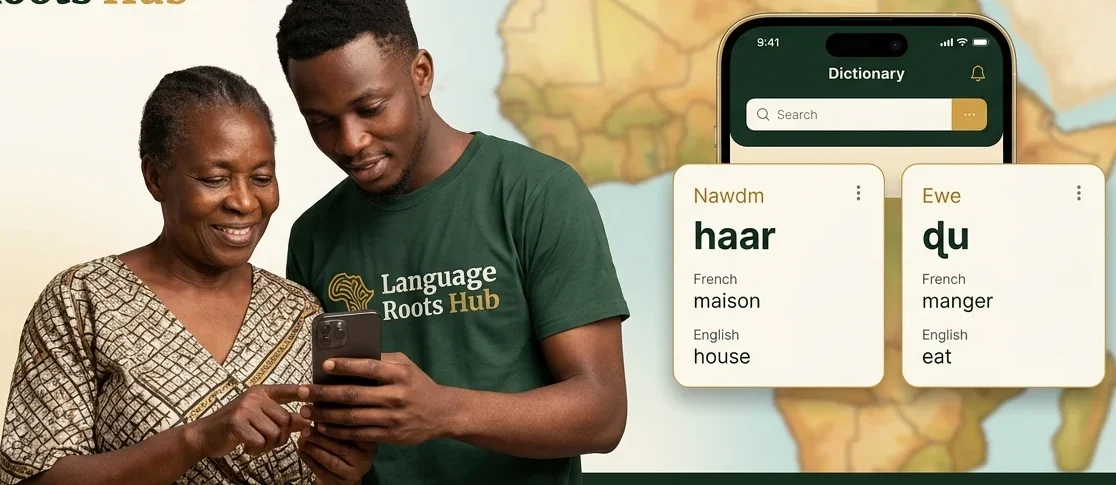
Digital dictionaries can make indigenous languages more accessible to students, researchers and speakers around the world.
4. Translating educational materials
Translating educational books, religious materials, health information and other important resources into indigenous languages can increase their practical value.
5. Developing artificial intelligence for African languages
Artificial intelligence offers opportunities to develop:
- English-to-Kwa translation systems
- French-to-Kwa translation systems
- Speech-to-text applications
- Text-to-speech applications
- Language-learning platforms
- Digital dictionaries
- Grammar-checking tools
6. Recording oral traditions
Traditional stories, songs, proverbs, folktales and historical accounts should be recorded and preserved in their original languages. These recordings can become valuable resources for future generations.
11. Conclusion
Kwa languages occupy an important position in the linguistic and cultural history of West Africa. From Akan in Ghana to Ewe in Ghana and Togo, Ga and Dangme around Accra, and Fon in Benin, these languages represent a rich heritage of communication, cultural identity and historical development. Their relationships with other Niger-Congo languages demonstrate the complexity of African linguistic history.
However, the study of Kwa must go beyond simply grouping languages according to geographical location or similarities in pronunciation. It requires careful comparative research into vocabulary, grammar, sound changes and historical relationships.
Ghana, in particular, has an important role in the study of these languages because it contains several major language groups associated with the Kwa classification, alongside numerous smaller and less documented languages.
Preserving these languages is not merely an academic responsibility. It is also a cultural responsibility. Every indigenous language carries knowledge, experiences, expressions and ways of understanding the world. When a language disappears, part of humanity’s linguistic and cultural heritage is lost.
It is therefore important to encourage the documentation, teaching, writing, translation and digital development of African languages so that future generations can continue to learn, speak and appreciate their linguistic heritage.
12. References and Further Reading
The following publications and research resources are particularly useful for readers who want to study Kwa languages at a deeper academic level.
- Jeff Good (2018). Niger-Congo Languages. An academic overview of the Niger-Congo family, its classification and major subgroups.
- Ben Elugbe. Issues in the Classification of West Benue-Congo. A useful discussion of the historical classification of Kwa and Benue-Congo and the reasons for subsequent changes.
- Tom Güldemann (Editor, 2018). The Languages and Linguistics of Africa. An important scholarly publication examining African languages and their historical and comparative classification.
- Hounkpati B. C. Capo (1991). A Comparative Phonology of Gbe. An important reference for understanding the linguistic relationships among Gbe languages.
- Felix K. Ameka and Mary Esther Kropp Dakubu (Editors, 2008). Aspect and Modality in Kwa Languages. This publication examines grammatical structures in Akan, Dangme, Ewe, Ga and other languages.
- Matthew E. Kropp Dakubu (2017). Sub-classifying the Languages of the Lower Volta Valley: Towards Redefining Kwa. An important contribution to discussions about the classification of Kwa and Ghana-Togo Mountain languages.
- U.S. Air Force Culture and Language Center (2025). Ghana Expeditionary Culture Field Guide. Contains an overview of Ghana’s linguistic and cultural landscape.
- University of Ghana (2018). The Phonology of Akan Loanwords in Ga and Dangme. An academic study demonstrating linguistic contact and the adaptation of borrowed words between Akan, Ga and Dangme.
13. Important Clarification for Researchers
When writing about Kwa languages, it is advisable to distinguish between three concepts:
| Concept | Meaning |
|---|---|
| Genealogical classification | Languages that share a demonstrable common ancestor |
| Typological classification | Languages that share structural characteristics |
| Geographical classification | Languages spoken within the same geographical region |
These three classifications are not interchangeable. For example, two languages may share similar grammatical structures because of geographical contact without necessarily belonging to the same immediate language family. Similarly, languages may share an ancestral origin but develop very different grammatical systems over time. This distinction is particularly important when studying Kwa, Guan and Ghana-Togo Mountain languages.
A note on Ghanaian statistics: Some cultural and linguistic reference publications estimate that approximately 69% of Ghanaians speak Kwa languages. This should be treated as an estimate from the particular reference, not as a definitive current census figure. Speaker statistics depend on whether researchers count first-language speakers, second-language speakers or both.
Article prepared for educational and linguistic reference. The classification follows established comparative research while acknowledging areas where scholarly debate continues.
Leave a Reply