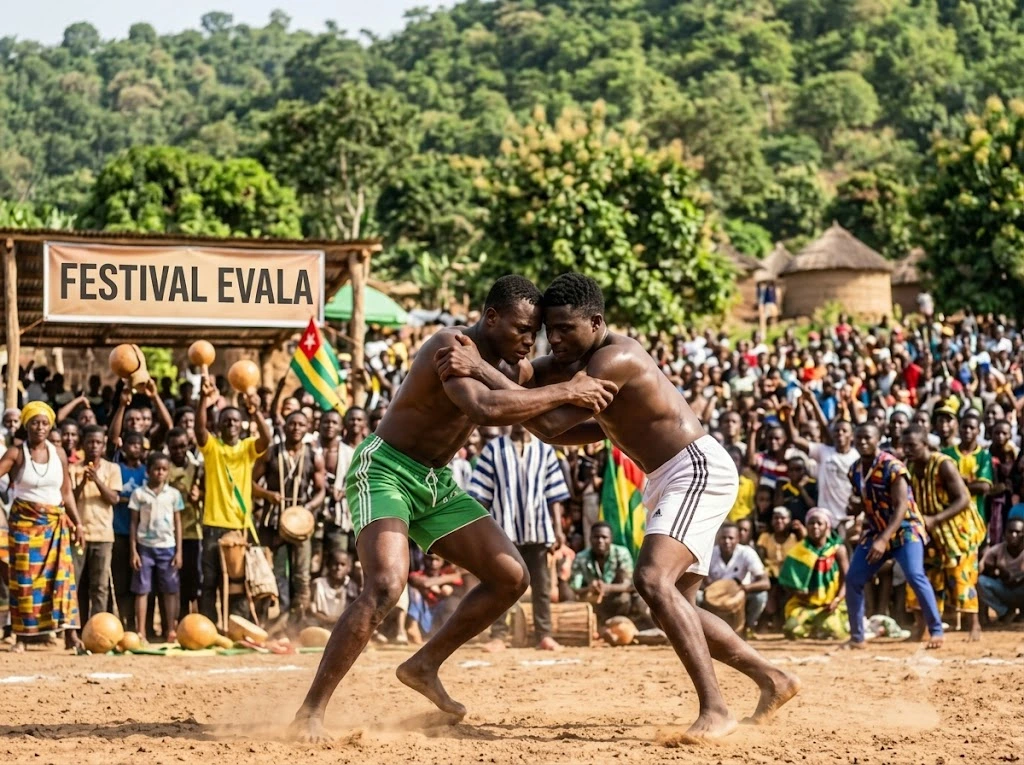
In July every year, in the Kara Region of northern Togo, young men go into the mountains.
They fast. They maintain celibacy. They climb three specific peaks. They spend a week separated from their families, living in special huts, being prepared by elders for what comes next. And then they wrestle.
This is Evala, the Kabiyè male initiation ritual, and it is probably the most talked-about cultural practice in northern Togo. But the Kabiyè are more than their wrestling tradition. They are the second-largest ethnic group in Togo, a farming community with a language that carries its own history, a complex kinship system, and a political presence in modern Togo that no serious account of the country can ignore.
Origins
According to Kabiyè mythology, the first Kabiyè descended from heaven into a village called Lama Dessi. The exact spot is known as Eyu nahori, which translates roughly as “the foot of man.” There is a sacred grove there today, and the footprints of Awu, the first ancestor who Eso (God) brought into the world, are revered as the founding point of the community.
 Oral tradition among older Kabiyè also points toward Kete-Krachi in Ghana as a more recent place of origin, suggesting a migration into northern Togo within the last few centuries. Either way, the Kara Region has been their home long enough that the landscape and the culture have shaped each other thoroughly. The Kabiyè became experts at farming stony mountain terrain, using terrace cultivation methods that allow them to work land most other communities would leave alone.
The Language
Kabiyè is a Gur language, part of the same broad Niger-Congo family as Nawdm, spoken by their neighbors to the east in the Doufelgou District. The two communities have lived side by side for generations. There has been mutual cultural influence and a shared landscape. But the languages are not mutually intelligible. Kabiyè has its own sound system, its own vocabulary, and its own grammatical structures.
With around 800,000 to one million speakers in Togo, and additional communities in northern Benin (where they are known as Lokpa or Lukpa) and northern Ghana, Kabiyè holds the status of one of Togo’s two official national languages alongside Ewe. It is used in primary school education and in national radio programming, which gives it more institutional support than most languages in the region.
For a full account of how the Kabiyè dictionary was assembled, see Building a Digital Dictionary for Kabiyè.
Evala: What the Wrestling Is Really About
The Evala ceremony happens every July in the Kozah Province around Kara. Young men spend a week in isolation, undergoing mental and physical preparation before a mountain pilgrimage and then the wrestling competition. The word Evala loosely translates as “new men” (Kabiyè: efalu), and that is exactly what the ritual is designed to produce.
The wrestling is not a sport in the competitive-league sense. There are no final rankings, no championships, no trophies. What matters is that the young man shows up, competes, and behaves with courage. Winning brings honor to the family. Losing is considered shameful. But the initiation itself is conferred regardless of the outcome, because showing up and fighting is the point.
Before the wrestling, participants go on a pilgrimage that involves climbing three mountains. Those who do not complete the climb are not initiated. The preparation includes fasting, sexual abstinence, and scarification as outward signs of the warrior identity. The entire process is presided over by elders who have been through it themselves. A young man who refuses the initiation faces real social consequences, effectively excluded from full adult community membership.
There is also Akpema, a parallel initiation ceremony for young women, marking their own transition to adulthood through different practices and ceremonies.
How Kabiyè People Live
The Kabiyè are farmers. Millet, yams, and cotton are their main crops, grown on land that demands persistent effort and careful water management. Many families also raise livestock. The terrace farming methods the Kabiyè have developed on the rocky Kara terrain are a practical solution to an agricultural challenge that most outside communities would not attempt.
In recent decades, many Kabiyè have moved south to work as seasonal migrant laborers, returning north for planting season, for harvest, and for Evala each July. This pattern is similar to what happened with the Nawdba further east, where a large portion of the community now lives outside the traditional homeland.
Community life is patrilineal and deeply collective. Decisions about land, marriage, and community disputes involve elders and structures that have been in place for generations. The identity of being Kabiyè carries weight in every context.
Neighbors and Connections
The Kabiyè share the Kara Region with several neighboring groups. To the east, in the Doufelgou District, are the Nawdba, who speak Nawdm. The two communities have coexisted as neighbors for a long time, and while there has been mutual cultural influence, the languages and traditions are distinct. The Lamba are another neighboring group in the same region.
These relationships across the northern Togo highland corridor are part of what makes the region culturally rich. Multiple farming communities have adapted to the same difficult terrain in ways that differ from each other, producing distinct languages, distinct initiation traditions, and distinct ways of organizing family and community life.
Why a Dictionary Matters
Kabiyè has official status and more institutional support than most languages in its geographic area. But official recognition does not automatically translate into accessible digital resources. As we explored in Why So Many African Languages Are Missing From the Internet, the gap between what languages exist and what languages get usable digital tools remains wide even for recognized languages.
The Kabiyè dictionary on Language Roots Hub sits alongside the Nawdm dictionary in the same spirit: a free, searchable, open-access resource for speakers, learners, and researchers. If you are thinking about learning Kabiyè, Five Practical Tips for Learning a Language With No Textbook is a good starting point.
Kabiyè speakers who find errors or missing vocabulary are encouraged to share feedback. The goal is a dictionary the community trusts, not just one that exists.
Sources: Wikipedia: Kabye people | 101 Last Tribes: Kabye | Traditional Sports: Evala (Togo) | My African Magazine: Initiation Wrestling in Togo | Joshua Project: Kabiye in Togo
Leave a Reply