Kabiyè is the language of the Kabiyè people, rooted in the mountainous Kara Region of northern Togo. It is one of only two languages, alongside Ewe, officially recognized as a national language of Togo, even though French remains the language of government and formal education. For a country with dozens of local languages, that recognition says something about how central Kabiyè is to Togolese life.
Origins and Homeland
The Kabiyè heartland sits in the rugged hill country around the city of Kara, stretching toward towns like Pagouda and Kétao. According to regional oral history, the Kabiyè and their neighbors settled in this mountainous terrain partly for protection, since the hills offered natural defense during centuries of slave raiding across the wider region. That same pattern of highland settlement shows up among other Gur-speaking peoples in this part of West Africa, including the Nawdm people covered elsewhere on this site.
The terrain shaped more than just settlement patterns. Farming on steep slopes, terracing, and tightly knit village structures all became part of Kabiyè life, and the language carries vocabulary and expressions tied closely to that landscape.
Who Speaks Kabiyè
Estimates commonly put the number of Kabiyè speakers somewhere between 900,000 and just over a million, most of them concentrated in Togo’s Kara Region. Communities of Kabiyè speakers are also found across the border in Ghana, part of the same cross-border movement that has carried other Gur-speaking groups from northern Togo into Ghana’s Oti and Volta regions over the past century.
Because Kabiyè holds national language status in Togo, it is used in local radio broadcasts, primary-level literacy programs, and community life well beyond the villages where it originated.
Linguistic Classification
Kabiyè belongs to the Gur branch of the Niger-Congo family, the same branch that includes Nawdm. If you’ve read our piece on the Gur and Kwa language families, you’ll recognize the pattern: Gur languages developed in the interior savanna and hill zones of West Africa, and they share a set of structural features that set them apart from coastal Kwa languages like Twi, Ewe, and Ga.
Two of those shared Gur features stand out clearly in Kabiyè:
It is tonal. The pitch at which a word is spoken can change its meaning entirely, the same way it does in Nawdm. This isn’t a minor accent feature. It’s a core part of how the language encodes meaning.
It uses a noun class system. Like many Gur languages, Kabiyè nouns are grouped into classes that affect how words agree with each other in a sentence, a structural trait that runs deep across this branch of Niger-Congo.
Writing Kabiyè
Kabiyè is written using a Latin-based alphabet, developed over the twentieth century with support from missionary linguists and organizations such as SIL International, largely for the purposes of Bible translation and literacy work. As with most Gur and Kwa language orthographies in this region, the alphabet includes a handful of additional characters beyond the standard English or French set, used to represent sounds that don’t map cleanly onto Latin letters.
Kabiyè and the Evala Tradition
Language and culture are hard to separate in Kabiyè life, and nowhere is that clearer than during Evala, the annual wrestling and initiation festival held in the Kara Region every July. We’ve covered the Evala Festival in detail, but it’s worth repeating here: the chants, songs, and ceremonial speech that run through Evala are Kabiyè at its most alive, carrying the language into its next generation the way festivals often do best.
Why Kabiyè Matters Today
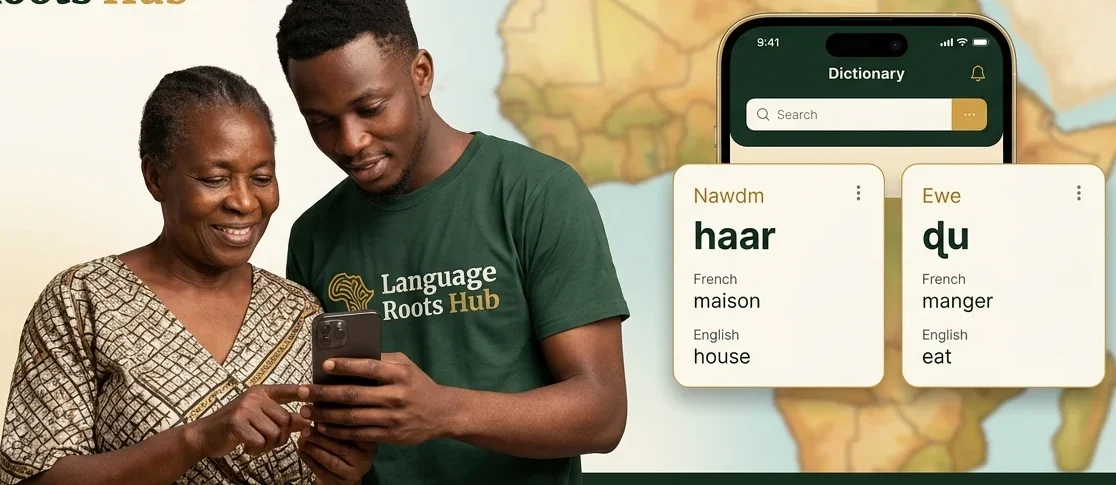
A national language spoken by close to a million people should, in theory, have no shortage of documentation. In practice, digital resources for Kabiyè remain thin compared to larger regional languages. That’s part of why this project built out a Kabiyè dictionary, drawn from legacy source material and made searchable for anyone learning or reconnecting with the language, alongside a Kabiyè phrasebook for those who want it in printed, everyday form.
Kabiyè sits alongside Nawdm, Ewe, Twi, and Ga as one of the five languages this project is built around, representing the Gur branch’s presence in a site that otherwise leans heavily toward the coastal Kwa languages. Read more about the project on the About page.

Leave a Reply